

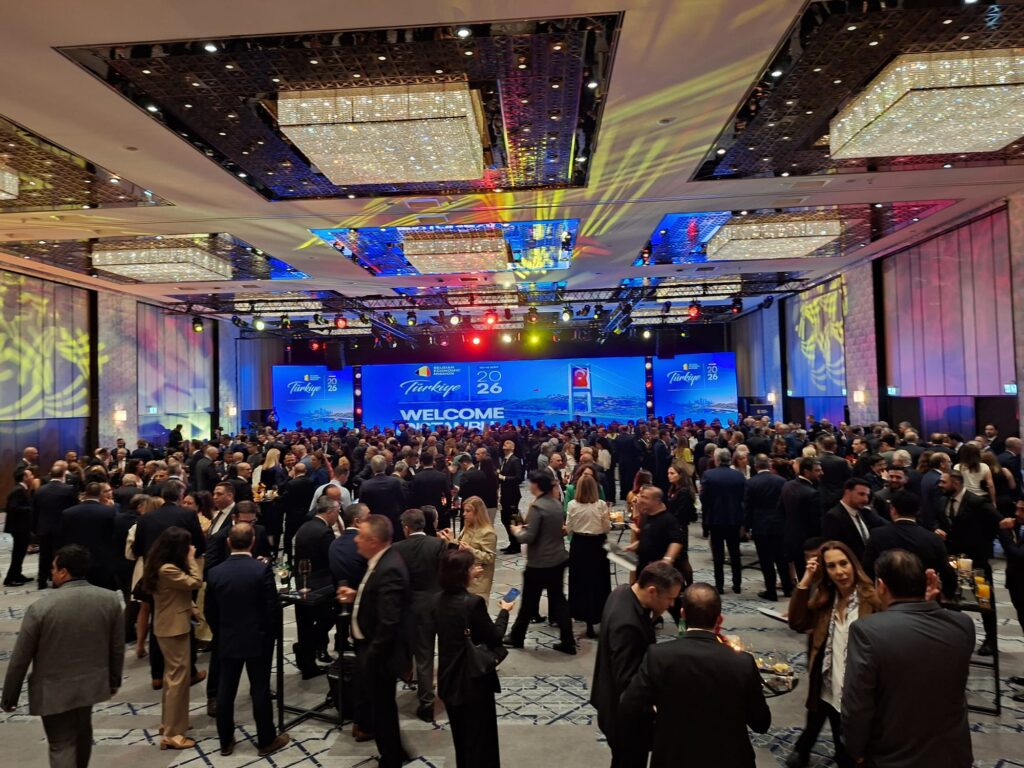
Belgium and Türkiye have maintained close economic and political relations for decades, shaped by strong trade ties, NATO cooperation, industrial integration, and a large Turkish diaspora in Belgium. In recent years, however, those relations have begun to acquire a new strategic dimension. As Europe confronts a rapidly deteriorating security environment, Türkiye is increasingly being viewed not only as a commercial partner, but also as a geopolitical actor central to the continent’s future security architecture.
Against this backdrop, Queen Mathilde’s economic mission to Türkiye from 10 to 14 May 2026 carried significance well beyond traditional trade diplomacy. The visit — the first Belgian economic mission ever presided over by Queen Mathilde — brought together 428 participants, 194 companies, and several senior political figures, including Foreign Minister Maxime Prévot and Defence Minister Theo Francken. Spanning sectors such as defence, logistics, aerospace, energy transition, digital transformation, pharmaceuticals, and financial services, the mission reflected the growing strategic convergence between Brussels and Ankara.
More broadly, the visit illustrated how relations between Europe and Türkiye are increasingly being shaped not only by debates over democratic standards or accession politics, but by questions of security, industrial resilience, military capability, and geopolitical necessity.
Europe’s Security Environment Has Fundamentally Changed
The significance of the Belgian mission can only be understood within the broader transformation of Europe’s security landscape. Since the Russian invasion of Ukraine in 2022, the foundations of the post-Cold War order have steadily eroded. By 2026, several developments had accelerated this shift simultaneously: uncertainty surrounding long-term American commitment to European security, divisions among Western allies over Middle East policy, intensifying defence-industrial competition, and the vulnerability of global supply chains.
Across Europe, a growing consensus has emerged that the continent can no longer rely exclusively on the United States for its security architecture and must strengthen its own strategic capabilities.
In this context, Türkiye has re-emerged as a pivotal actor. The country controls the Turkish Straits linking the Black Sea to the Mediterranean, fields NATO’s second-largest standing military, and borders regions central to Europe’s security concerns, including Syria, Iraq, Iran, and the Caucasus. At the same time, Türkiye’s defence industry has undergone a rapid transformation over the past decade. During his April 2026 visit to Ankara, NATO Secretary General Mark Rutte described Türkiye’s defence-industrial progress as “a revolution in defence industry.”
Turkish-made drones, electronic warfare systems, armoured vehicles, naval platforms, and missile technologies are increasingly attracting attention across Europe. Countries on NATO’s eastern flank recognised Türkiye’s growing strategic relevance early on; Western European capitals are now moving in the same direction. The Belgian mission represented one of the clearest signs of this broader European recalibration.
Realpolitik Is Replacing Normative Diplomacy
The Belgian mission also reflected a wider shift in Europe’s approach toward Türkiye: the gradual replacement of purely normative diplomacy with a more pragmatic and strategic framework.
This does not mean that concerns related to human rights, democratic standards, or press freedom have disappeared from the European agenda. However, their relative weight within European policymaking has changed considerably as security concerns intensify.
Across several European capitals, policymakers increasingly view Türkiye through the lens of strategic necessity rather than solely through the framework of accession negotiations or political conditionality. Foreign Minister Maxime Prévot captured this shift clearly when he stated that “it is not possible to discuss a European security architecture without Türkiye.” He also argued that Türkiye “must not be contained or constrained,” signalling a noticeably more pragmatic tone from a senior representative of an EU founding member state.
Defence Minister Theo Francken expressed similar views during his visit to Baykar’s Özdemir Bayraktar National Technology Centre in Istanbul, which he visited alongside Belgian army chief Frederik Vansina. Francken described Baykar as a “unique actor within NATO” and emphasised the company’s innovation-driven model, particularly in unmanned systems and next-generation military technologies.
The symbolism of the visit was significant. Belgian interest was no longer limited to commercial engagement alone; it increasingly reflected Europe’s search for reliable industrial and technological defence partnerships within NATO.
The NATO Summit and Türkiye’s Strategic Centrality
The timing of the Belgian mission was also highly significant. Less than two months later, Türkiye will host the NATO Leaders Summit in Ankara on 7–8 July 2026 — only the second NATO summit ever hosted by Türkiye at head-of-state level after Istanbul in 2004.
The summit is expected to focus heavily on defence-industrial expansion, military readiness, cybersecurity, critical infrastructure protection, and burden-sharing within the alliance. It also comes at a moment when NATO is adapting to a far more unstable strategic environment.
For Ankara, hosting the summit represents both diplomatic prestige and strategic validation. Türkiye continues to occupy a central position within NATO thanks to its geography, military capabilities, and growing defence-industrial ecosystem. Ankara also sees the summit as an opportunity to strengthen its case for deeper integration into European defence initiatives and procurement frameworks.
The bilateral meetings held during the Belgian mission — including Queen Mathilde’s audience with President Recep Tayyip Erdoğan and discussions between Belgian and Turkish defence officials — should also be viewed within this broader pre-summit context.
Belgium’s institutional position adds particular weight to this engagement. As host of NATO headquarters and one of the European Union’s founding states, Belgium possesses influence within both transatlantic and EU structures disproportionate to its size. From Ankara’s perspective, strengthening ties with Brussels carries strategic value far beyond bilateral trade alone.
Defence Cooperation Moves From Symbolism to Substance
While the Baykar visit attracted most public attention, the broader defence-industrial dimension of the mission quickly evolved beyond symbolism.
On 13 May, the first “Türkiye-Belgium Defence Industry Day” was organised at the headquarters of Türkiye’s Presidency of Defence Industries (SSB) in Ankara. Belgian and Turkish defence companies participated in structured bilateral meetings that resulted in six strategic cooperation agreements.
Among the most significant was the memorandum of understanding signed between SAHA Istanbul and Agoria BSDI, creating a framework for joint innovation, technological cooperation, and industrial coordination between the two countries’ defence and aerospace sectors.
Another notable agreement involved FNSS and John Cockerill Defense, focusing on joint development opportunities in armoured vehicle systems and international market cooperation. The partnership reflects growing Belgian interest in Türkiye’s rapidly expanding land systems industry.
Belgian aerospace company Sonaca also signed agreements with Turkish Aerospace Industries (TUSAŞ), highlighting the increasing integration potential between Turkish and European aerospace supply chains.
Additional agreements involving Aselsan, XO Advanced Systems, BTMco, ABC, ALTUNA International Engineering, and New Lachaussee demonstrated that cooperation is extending beyond flagship defence companies into broader industrial networks and SME ecosystems.
The Belgian delegation also visited several major Turkish industrial facilities, including BMC, FNSS, SEDEF Shipyard, and Teknopark Istanbul. These visits provided Belgian officials and executives with direct exposure to Türkiye’s rapidly developing defence-technological infrastructure and R&D ecosystem.
Particularly important was the visit to Teknopark Istanbul, where Belgian representatives met startups and deep-tech firms operating in sectors ranging from artificial intelligence to autonomous systems and cybersecurity. The scale of Türkiye’s defence innovation ecosystem increasingly suggests a long-term industrial strategy rather than isolated successes by individual companies.
SAFE, the Customs Union, and Europe’s Defence Architecture
Behind the bilateral agreements lies a much larger institutional issue: Türkiye’s relationship with the European Union’s emerging defence-industrial architecture.
Ankara has been seeking access to the EU’s €150 billion SAFE (Security Action for Europe) programme, designed to strengthen Europe’s defence production and procurement capacity. European Commission officials have indicated openness to cooperation with Turkish defence firms, particularly given Türkiye’s industrial scale and NATO integration.
However, direct Turkish participation in SAFE procurement structures would require a formal agreement between Türkiye and the European Union — something that remains politically sensitive due to opposition from Greece and Cyprus.
For Ankara, this issue is closely linked to several long-standing priorities: modernisation of the 1996 EU-Türkiye Customs Union, expanded access to European markets, visa liberalisation, and deeper integration into European industrial supply chains.
Belgium could potentially play an important facilitating role within EU institutions. During the mission, Belgian officials expressed support for stronger economic integration and renewed discussion on Customs Union modernisation. Given Belgium’s institutional influence within the EU and its already substantial economic ties with Türkiye, Ankara views Brussels as a potentially important partner in advancing these discussions.
The broader European debate is also evolving. Increasingly, policymakers in Brussels view Türkiye not simply as a neighbouring market, but as an industrial and strategic actor deeply integrated into Europe’s economic ecosystem.
Trade, Logistics, and the 15 Billion Euro Objective
Although defence cooperation dominated much of the political attention surrounding the mission, the broader economic agenda remained extensive.
Bilateral trade between Belgium and Türkiye reached approximately €9 billion in 2025. Both governments now aim to raise that figure to €15 billion over the medium term. Belgium is already among the largest foreign investors in Türkiye, with cumulative investments approaching $8 billion.
During the mission, around 30 agreements were signed across sectors including logistics, healthcare, digital transformation, food industries, education, technology, and energy.
Particular emphasis was placed on sustainable trade, supply-chain resilience, digital infrastructure, healthcare technologies, renewable energy, and international contracting.
The logistics dimension was especially important. Turkish officials highlighted Türkiye’s position as a strategic connectivity hub linking Europe, Asia, the Caucasus, and the Middle East. Projects such as the Middle Corridor and the Development Road initiative connecting the Gulf region to Europe via Iraq and Türkiye are increasingly viewed as major alternatives within global trade and transport networks.
For Belgian actors specialised in ports, logistics management, and maritime infrastructure, these developments represent significant long-term opportunities.
The mission also included softer dimensions of cooperation, including education, sports infrastructure, and cultural ties. The visit to Galatasaray High School and meetings linked to UEFA Euro 2032 infrastructure projects illustrated the broader societal dimension of Belgium-Türkiye relations beyond economics and defence alone.
Türkiye’s Strategic Autonomy: Opportunity and Constraint
At the same time, Europe’s growing engagement with Türkiye also raises important strategic questions.
Ankara continues to pursue a policy often described as “strategic autonomy.” Türkiye maintains active relations with both Western allies and actors such as Russia, while simultaneously positioning itself as a mediator in multiple regional crises.
Türkiye has supplied military equipment to Ukraine while maintaining economic and diplomatic channels with Moscow. It has participated actively in NATO deterrence efforts while also preserving broader regional balancing strategies.
For European policymakers, this dual positioning creates both opportunities and discomfort.
On one hand, Türkiye’s ability to maintain dialogue across geopolitical divides increases its diplomatic value. On the other hand, some European analysts remain concerned about excessive dependence on Turkish industrial or strategic capacities, particularly given past tensions surrounding migration policy, sanctions, and defence procurement.
The S-400 episode and Türkiye’s exclusion from the F-35 programme continue to shape perceptions in parts of Europe and Washington.
As a result, European engagement with Türkiye increasingly follows a calibrated approach: deepening industrial and strategic cooperation while avoiding forms of dependency that could become politically sensitive in the future.
The Belgian mission reflected precisely this balancing logic.
SAHA 2026 and Europe’s Growing Interest in Turkish Defence Technologies
The Belgian mission also took place shortly after SAHA 2026, Türkiye’s major defence, aerospace, and space exhibition held in Istanbul from 5–9 May.
The exhibition highlighted the rapid evolution of Türkiye’s defence-industrial ecosystem, showcasing Aselsan’s electronic warfare platforms, counter-drone technologies, laser-based defence systems, autonomous interception capabilities, advanced armoured vehicles, and next-generation missile technologies.
European interest in these developments has increased considerably over the past two years.
Particular attention in European defence circles has focused on projects such as the Tayfun Blok air defence system and the publicly referenced “Yıldırımhan” missile programme. Meanwhile, the Baykar-Leonardo partnership has become one of the clearest examples of growing European-Turkish industrial integration in defence production.
Taken together, these developments illustrate that Türkiye is increasingly being viewed not merely as a defence customer, but as a defence-industrial partner capable of contributing directly to Europe’s expanding military production ecosystem.
What Comes Next
The Belgian economic mission established several important political and industrial foundations that are likely to shape bilateral relations well beyond 2026.
The cooperation framework between SAHA Istanbul and Agoria BSDI may evolve into a long-term institutional platform for industrial coordination. The Türkiye-Belgium Defence Industry Day format could also become a recurring mechanism for bilateral engagement.
At the European level, discussions surrounding SAFE participation, Customs Union modernisation, and industrial integration are expected to continue intensifying in the months ahead.
The NATO summit in Ankara will provide the next major political milestone. Whether Belgium eventually moves toward direct procurement partnerships with Turkish defence companies remains uncertain, but the mission clearly demonstrated that such discussions are no longer politically marginal.
At the societal level, the approximately 300,000-strong Turkish community in Belgium continues to represent an important bridge between the two countries — reinforcing ties that increasingly extend across trade, education, technology, security, and culture.
Conclusion: A Strategic Relationship Entering a New Phase
The 2026 Belgian Economic Mission to Türkiye demonstrated that relations between Europe and Türkiye are entering a new strategic phase shaped increasingly by geopolitical realities rather than solely by the political frameworks that dominated the previous decade.
The mission took place at the intersection of several major transformations: the restructuring of Europe’s security architecture, the rapid expansion of European defence-industrial needs, the search for more resilient supply chains, and the growing importance of strategic middle powers within NATO.
Belgium brought to Ankara more than commercial interest alone. As an EU founding state and host of NATO headquarters, its engagement carried institutional and political significance. The strong presence of senior Belgian political figures — particularly Queen Mathilde, Theo Francken, and Maxime Prévot — reflected a broader recognition that Türkiye has become increasingly difficult to exclude from Europe’s long-term strategic calculations.
The agreements signed during the mission are important in themselves. But the broader significance of the visit lies elsewhere: in what it reveals about Europe’s evolving geopolitical mindset.
Across much of Europe, a more pragmatic approach toward Türkiye is gradually emerging — one shaped less by ideological expectations and increasingly by strategic realities. In a fragmented international environment marked by security competition, industrial pressures, and geopolitical uncertainty, partnerships are increasingly being evaluated through the lens of mutual interests, capabilities, and resilience.
The Belgian mission to Türkiye may ultimately be remembered less as a trade delegation than as a clear indication of that wider European transition.
