

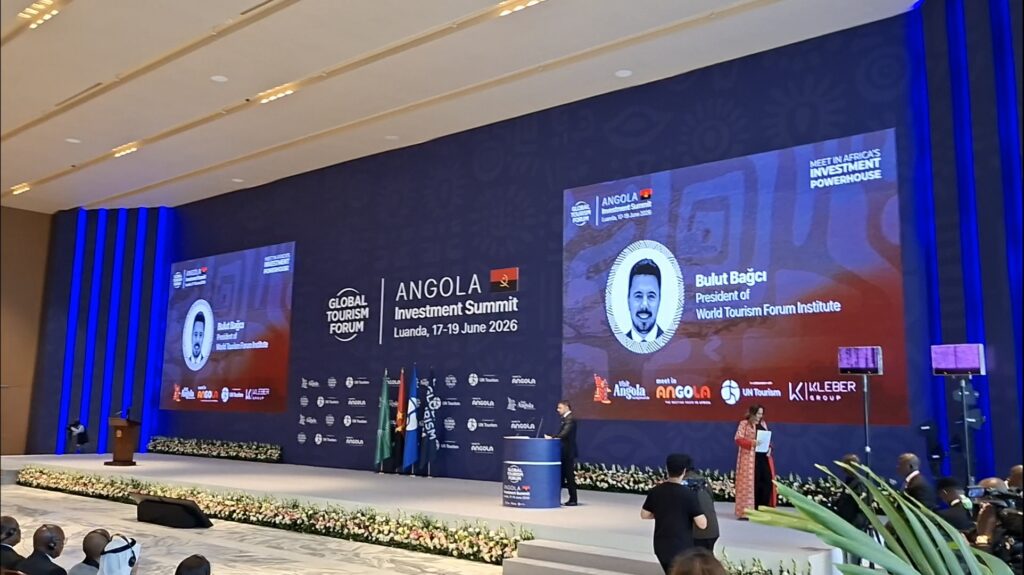
LUANDA — Angola formally opened the Global Tourism Forum (GTF) Investment Summit Angola 2026 this week in Luanda, a three-day gathering running from 17 to 19 June that has brought together more than a thousand investors, policymakers and tourism industry executives in the Angolan capital.
The opening ceremony was presided over by President João Lourenço and attended by Mozambican President Daniel Chapo, lending the proceedings a distinctly regional character and underscoring the summit’s ambition to extend beyond Angola’s borders into a broader conversation about tourism investment across Southern Africa.
Organised by the Angolan government in partnership with the World Tourism Forum Institute (WTFI), the summit is being held under the theme « Shaping the Future of Tourism in Emerging Destinations. » Its purpose is threefold: to channel international capital towards tourism projects of national and provincial significance, to advance Angola’s strategy of economic diversification away from oil, and to strengthen public-private cooperation in sectors ranging from hospitality and aviation to ecotourism and digital infrastructure.
A particularly significant moment was the signing of three Memoranda of Understanding (MOUs), one of which was concluded with the major international tourism group TUI, represented by Wissam Okasha. The other two MOUs are expected to be signed later in the course of the event.
Tourism Investment at the Heart of Angola’s Diversification Strategy
For more than a decade, Angola’s economy has remained heavily dependent on petroleum revenues, a structural reality that has left the country vulnerable to fluctuations in commodity prices and constrained the diversification of its economic base. Increasingly, however, Angolan policymakers have sought to position tourism not as a peripheral activity but as a strategic pillar of national development.
Government officials argue that tourism investment can generate employment, attract foreign direct investment and stimulate a wide range of related industries, including construction, transport, agriculture, hospitality and digital services. In this context, the Global Tourism Forum Angola 2026 represents the most visible expression yet of Angola’s effort to reposition itself as one of Africa’s most promising emerging tourism destinations.
This shift has been reinforced by a series of developments over the past year, including the operationalisation of the Dr. António Agostinho Neto International Airport, the expansion of visa-free access to citizens of numerous countries and Angola’s designation as the official host country of ITB Berlin 2026. Together, these initiatives form part of a broader strategy aimed at improving the country’s attractiveness to investors and international visitors alike.
Among the international figures attending the summit were Shaikha Al Nowais, Secretary-General of UN Tourism; Bulut Bağcı, President of the World Tourism Forum Institute; and Gloria Guevara, President and CEO of the World Travel and Tourism Council (WTTC). Their presence, alongside delegations from Mozambique, Zambia and Zimbabwe, reflects the summit’s ambition to position Angola within a wider continental discussion about tourism development and investment.
Tourism Moves to the Centre of Economic Policy
In his opening remarks, President João Lourenço described tourism as having moved from the margins of economic policy to its centre, presenting it as a key component of Angola’s long-term reform agenda. He pointed to the country’s 1,600-kilometre coastline, rich biodiversity and cultural heritage as assets capable of supporting a globally competitive tourism sector.
The President also highlighted ongoing investments in transport infrastructure, telecommunications and conference facilities, including the future Conference Palace in Luanda, as evidence of the government’s commitment to creating the conditions necessary for sustainable tourism growth. At the same time, he called for greater regional integration across Africa, arguing that improved air connectivity and more harmonised policy frameworks would be essential if African destinations are to compete effectively for global tourism investment.
Speaking on behalf of UN Tourism, Shaikha Al Nowais argued that confidence is steadily growing in Angola. She cited measures such as the expansion of visa-free access, the mobilisation of significant tourism financing through national programmes and Angola’s increasingly active role in international tourism discussions. Her central message was straightforward: investment follows confidence, and confidence in Angola’s tourism sector is rising.
Cabo Ledo Becomes the Flagship Tourism Investment Project
If one project has emerged as the symbol of Angola’s tourism ambitions, it is Cabo Ledo.
In March 2026, President Lourenço approved a €449 million infrastructure programme covering several priority tourism zones, with €249 million earmarked specifically for Cabo Ledo. The financing, provided through Mitsubishi UFJ Financial Group (MUFG), is intended to fund the foundational infrastructure that has historically limited private sector development despite sustained investor interest in the area.
Rather than promoting Cabo Ledo solely on the basis of its natural beauty, the government is seeking to present investors with a destination whose essential infrastructure is already financed. The programme will cover access roads, water and sanitation systems, electricity networks, telecommunications infrastructure and public lighting, thereby reducing investment risks and creating conditions more favourable to large-scale tourism projects.
Known for its dramatic coastline and internationally recognised surf beaches, Cabo Ledo is being positioned as a destination suitable for upscale hospitality, eco-resorts and leisure tourism. Officials view it as a pilot project for a broader coastal tourism corridor that would eventually extend to other sites, including Saco Mar, Tômbwa, Moçâmedes and Quicombo Bay.
The Dubai Comparison and Angola’s Long-Term Vision
The summit’s international dimension has also been reinforced by the involvement of Bulut Bağcı and the World Tourism Forum Institute, whose engagement with Angolan authorities developed through a series of international tourism and investment events, including discussions held on the sidelines of the World Economic Forum in Davos.
During a press conference held on the eve of the summit, Bağcı pointed to Dubai’s transformation over recent decades as an example of how tourism can reshape an economy when combined with strategic infrastructure investment and long-term planning. His argument was not that Angola should replicate Dubai, but rather that tourism can act as a catalyst for broader economic development.
According to Bağcı, tourism investment generates a multiplier effect that extends well beyond the sector itself, stimulating construction, aviation, transport, retail and agriculture while attracting additional capital into the wider economy. In his view, Angola possesses many of the ingredients necessary to become one of the continent’s most compelling investment frontiers.
From Visibility to Concrete Outcomes
At a press conference preceding the summit, Angola’s Secretary of State for Tourism, Augusto Laurindo Kalikemala, stressed that the success of the event would not be measured solely by attendance figures. While more than a thousand participants were expected in Luanda, he argued that the real objective was to attract high-quality investors capable of supporting long-term projects across the tourism value chain.
Kalikemala described a vision that extends beyond hotels and resorts to encompass transport infrastructure, hospitality, education and training, digital solutions, environmental sustainability and supporting public services. Tourism, he argued, should be understood as an interconnected ecosystem rather than a standalone industry.
Among the most tangible outcomes expected from the summit is the signing of five Memoranda of Understanding covering different segments of Angola’s tourism value chain. Officials have presented these agreements as evidence that the forum is intended to generate practical commitments rather than merely facilitate discussion.
Both Kalikemala and Bağcı acknowledged that Angola continues to face challenges in areas such as infrastructure, connectivity, investment facilitation and international visibility. Yet they insisted that these obstacles should be addressed directly rather than viewed as reasons for inaction.
Can the Global Tourism Forum Deliver Lasting Investment?
The central question facing the Global Tourism Forum Angola 2026 is whether the enthusiasm generated in Luanda can be converted into sustained investment flows over the coming years.
Angola has already improved air connectivity, simplified visa procedures and committed substantial resources to tourism infrastructure. The next stage will be translating this momentum into operational projects capable of creating jobs, attracting foreign capital and generating long-term economic returns.
For a country seeking to reduce its dependence on oil and redefine its place within the global economy, the success of projects such as Cabo Ledo may ultimately matter more than the summit itself. The true measure of the forum’s legacy will not be the visibility it generates this week, but whether it succeeds in turning international interest into lasting investment across Angola’s tourism sector.
