

Brussels Policy Roundtable Examines the Implications of Kazakhstan’s New Constitution
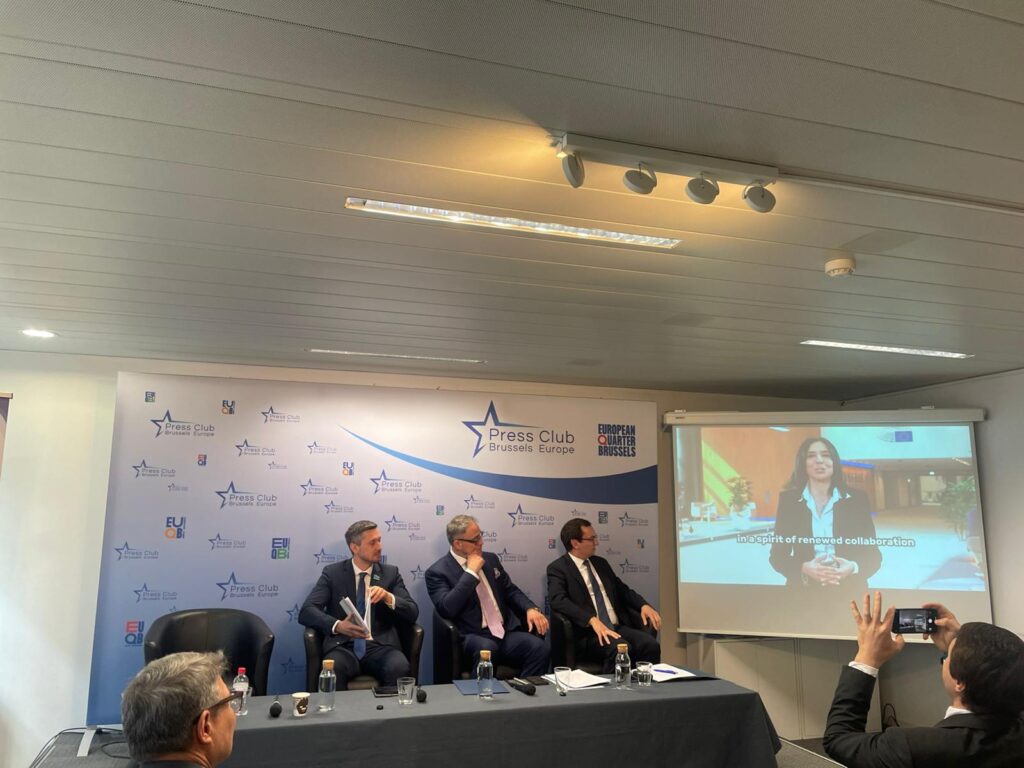
Brussels, 20 April 2026 — A high-level policy roundtable titled “A New Kazakhstan: Results of the Constitutional Referendum and the Path of Democratic Modernization” was held on Monday at the Press Club Brussels Europe, bringing together diplomats, policymakers, legal experts, and representatives of European institutions to assess the implications of Kazakhstan’s recent constitutional reform.
Organised in a context of profound geopolitical change across the wider Eurasian region, the discussion focused on the outcomes of Kazakhstan’s constitutional referendum held on 15 March 2026, the implementation of the new constitutional framework, and its significance for Kazakhstan’s domestic governance as well as its engagement with the European Union.
Opening and Welcoming Remarks
The event opened with introductory remarks delivered by Mr. António Buscardini, President of the Press Club Brussels Europe, who welcomed participants and underlined the importance of sustained dialogue between Central Asia and the European policy community.
Welcoming remarks were then delivered by Ambassador Roman Vassilenko, Head of the Mission of the Republic of Kazakhstan to the European Union. Ambassador Vassilenko highlighted that the constitutional referendum represents a key milestone in Kazakhstan’s ongoing political transformation and state-building process, as well as in its democratization.
“The referendum demonstrated the clear will of the people of Kazakhstan to support a new model of statehood based on deeper democracy, stronger institutions, and greater accountability.
By choosing reform through public participation, our citizens reaffirmed that the future of Kazakhstan must be shaped through dialogue, inclusion, and the rule of law.”
Kazakhstan is among the countries that have experienced rapid democratization in the post-Soviet era, a trend clearly illustrated by this referendum. In this regard, the Ambassador noted that:
“The constitutional changes are substantial and far-reaching.
They strengthen the balance of powers between the branches of government, enhance the role of Parliament, and increase the responsibility of local authorities.
They expand protections for human rights, reinforce the independence of the Constitutional Court, and create new mechanisms through which citizens can participate more actively in public life.”
He emphasized that the reform reflects the will of citizens to modernize governance institutions, enhance accountability, and strengthen democratic practices.
Finally, Ambassador Vassilenko noted that the referendum will bring Kazakhstan closer to the European Union:
“For our relations with the European Union, these reforms carry particular significance.
The European Union is one of Kazakhstan’s most important and trusted partners.
Our cooperation has always been grounded in shared interests: economic modernization, connectivity, sustainable development, energy security, education, and people-to-people ties.
But it is also increasingly based on shared norms—respect for the rule of law, institutional resilience, and citizen participation.
The constitutional transformation in Kazakhstan opens new opportunities to deepen our partnership under the Enhanced Partnership and Cooperation Agreement.
It creates stronger foundations for investor confidence, judicial predictability, and regulatory transparency.
These are essential elements for expanding trade, attracting European investment, and promoting innovation.”
It is worth recalling that Kazakhstan is widely recognized as the European Union’s most important partner in Central Asia, serving as its main trading partner and the leading destination for foreign investment—accounting for over 40% of total foreign investment in the region. Kazakhstan also plays a critical role in the EU’s energy security and green and digital transitions, supported by raw materials agreements and strengthened by the Enhanced Partnership and Cooperation Agreement (EPCA), as noted by the European External Action Service (EEAS).
In this context, the European institutional perspective was further enriched by Ms. Giusi Princi, Chair of the European Parliament’s Delegation for relations with Central Asia, who joined the event online. She stressed the European Union’s interest in stability, political reform, and the rule of law in Central Asia, noting that Kazakhstan plays a pivotal role in regional cooperation and connectivity.
Additional remarks were delivered by Ms. Marilyn Josefson, Foreign Policy Advisor at the Cabinet of the President of the European Council, who underlined the strategic relevance of Kazakhstan for the EU, particularly in areas such as energy security, transport corridors, and multilateral cooperation.
A New Constitutional Framework
The panel session, dedicated to the results of the constitutional referendum and the path of democratic modernization, examined why a new Constitution was proposed at this juncture and how it structurally differs from Kazakhstan’s previous constitutional framework.
On 15 March 2026, Kazakhstan’s citizens endorsed the new Constitution by an overwhelming 87 percent majority, signaling broad public support for far-reaching political reforms. Presented as a comprehensive reconfiguration of the country’s political architecture, the reform aims to recalibrate the balance of powers, strengthen checks and balances, and reinforce mechanisms of accountability.
Expert Perspectives and Policy Analysis
The first intervention was delivered by Mr. Evgeniy Bolgert, Secretary of the Committee on Constitutional Legislation, Judicial System and Law Enforcement Agencies of the Senate of the Parliament of the Republic of Kazakhstan.
He noted that this referendum has ushered Kazakhstan into a new era:
“Kazakhstan is entering one of the most pivotal moments of its political transformation, a development that has not occurred in the 35 years of independence.”
Mr. Bolgert emphasized that the reform is not merely a legal revision but an essential step toward building a more transparent, responsive, and accountable state. He also addressed the practical aspects of implementation and the institutional adjustments required in the coming phase.
“Our objective is to move away from legacy models of centralized, ‘super-presidential’ governance toward a system that is more resilient, transparent, and responsive.
We prioritize social harmony, inclusive dialogue, and mutual respect in our multi-ethnic society.
Our commitment remains firm: to support all ethnic groups while building a unified Kazakhstani identity, promoting the state language, and nurturing a sense of patriotism.”
He highlighted the importance of the separation of powers under the new Constitution:
“The reintroduction of the office of Vice-President and the expansion of the powers of our judicial and human rights institutions are designed to create a more sophisticated, multi-layered system of governance that distributes responsibility more effectively than in the past.”
He also noted that the new Constitution will strengthen human rights protections, with equality and social inclusion remaining key priorities for Kazakhstan. He recalled that Kazakhstan is currently recognized as a leader among countries with a very high level of gender equality under the Human Development Index.
The discussion was complemented by Mr. Alberto Turkstra, Project Director at Diplomatic World, who examined the reform from a comparative and international perspective. He noted that Kazakhstan’s constitutional transformation should be viewed within the broader context of evolving governance models across Eurasia, as well as the country’s growing engagement with European partners.
Mr. Turkstra highlighted the potential implications for Kazakhstan–EU relations, including greater predictability for European investors and strategic projects, particularly in the fields of energy cooperation, transport connectivity, and the development of the Trans-Caspian “Middle Corridor.”
Conclusion and Implications for Kazakhstan–EU Relations
A central theme of the discussion was how constitutional reform may affect Kazakhstan’s role as a regional actor and partner of the European Union. Participants explored whether the new governance framework could contribute to a more predictable political environment, thereby strengthening cooperation in trade, energy, transport, and regional security.
The exchange also addressed how reforms related to political pluralism, governance standards, and the rule of law could shape Kazakhstan’s engagement with EU institutions and its broader international positioning in Central Asia and beyond.
The panel concluded with an interactive Q&A session, allowing participants to engage directly with the speakers and reflect on the reform’s long-term trajectory and the challenges associated with its implementation.
Following the formal discussion, participants were invited to a standing networking reception, providing an opportunity for informal exchanges among diplomats, EU officials, experts, and representatives of civil society.
The roundtable underscored that Kazakhstan stands at a pivotal juncture in its development. For Brussels, the discussion reaffirmed Kazakhstan’s strategic importance and the European Union’s interest in supporting reforms that promote stability, accountability, and cooperation across Central Asia.
