

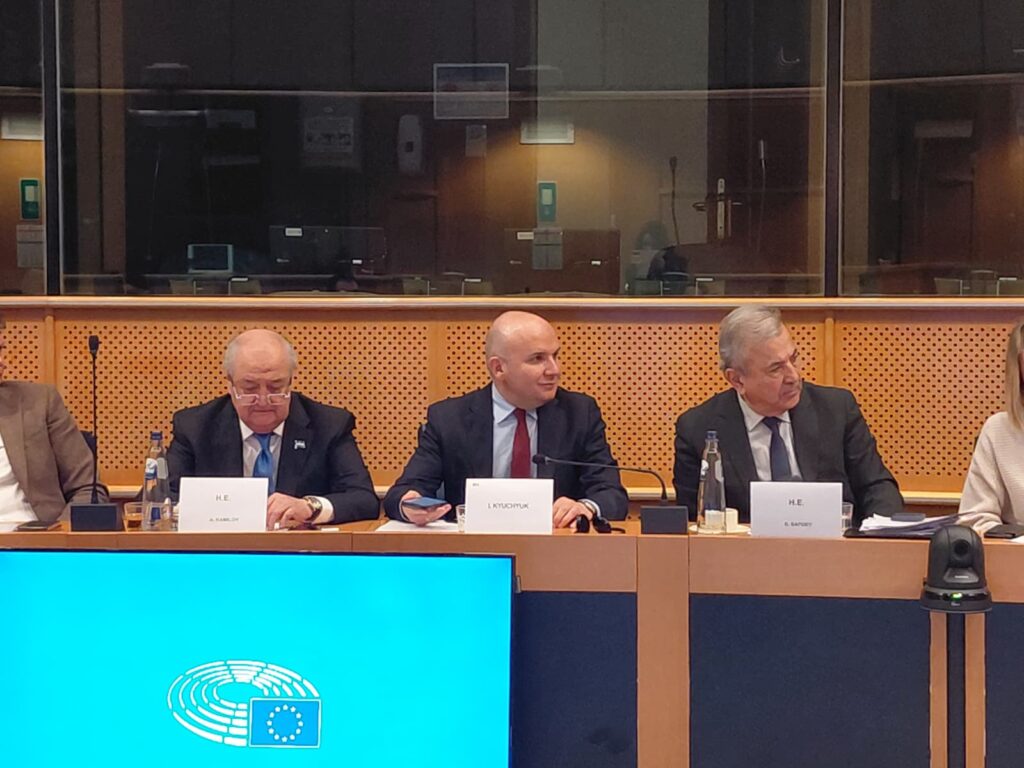
On 25 February 2026, the European Parliament in Brussels hosted a high-level conference titled “Reform and Engagement: The New EU–Uzbekistan Agenda.” The event brought together senior EU officials, Members of the European Parliament (MEPs), policy experts, and a high-ranking Uzbek delegation led by H.E. Sodiq Safoyev, First Deputy Chair of the Senate of Uzbekistan, and H.E. Abdulaziz Komilov, Special Representative of the President of Uzbekistan for Foreign Affairs.
Far from being a routine diplomatic exchange, the conference reflected a deeper geopolitical transformation. Central Asia is no longer perceived as a peripheral space but as a region of growing strategic weight—economically, demographically, and geopolitically. At the heart of this transformation stands Uzbekistan.
A Symbolic Opening
The event opened with a documentary film retracing Uzbekistan’s historical trajectory. The video evoked the Timurid era, Zuhriddin Muhammad Bobur, the scientific prominence of Samarkand, and the legacy of towering intellectual figures such as Ibn Sina. It also referenced Leonardo da Vinci to underline the global transmission of knowledge rooted in Central Asian scholarship. They also presented the new islamic civilization center constructed in Tashkent.
The imagery of Samarkand and the broader Timurid cultural renaissance conveyed a clear message: Uzbekistan is not merely reforming—it is reconnecting with a civilizational heritage that positioned it historically as a center of science, trade, and intercultural dialogue. The film also highlighted the country’s ambition to serve as a platform for multilateral cooperation in Central Asia.
This civilizational framing set the tone for the day’s discussions: reform in Uzbekistan is not an isolated domestic agenda but part of a broader regional reawakening.
The conference was organized under the leadership of MEP Ilhan Kyuchyuk, who opened the proceedings by emphasizing the transformative potential of the Enhanced Partnership and Cooperation Agreement (EPCA). He underlined Uzbekistan’s constructive regional role, particularly in fostering cooperation within Central Asia and maintaining engagement with Afghanistan.
Kyuchyuk outlined the day’s comprehensive program: remarks by Uzbek representatives, a documentary screening on reforms, analytical findings from the European Neighbourhood Council (ENC), and a roundtable involving officials from DG INTPA, the EEAS, the Oliy Majlis, and European Parliament delegations.
His remarks reflected a notable shift in tone: the relationship between the EU and Uzbekistan has moved beyond cautious engagement toward structured and forward-looking cooperation.
Sodiq Safoyev: the need of Stability
In his address, H.E. Sodiq Safoyev framed global politics as unstable and fragmented but positioned Central Asia as pursuing consolidation rather than division.
He described EU partnership as a “constant” in a world of variables—elevating the relationship beyond transactional diplomacy. Referring to milestones such as the EU–Central Asia Summit and the upcoming inter-parliamentary forum, he stressed institutionalization as the new phase of engagement.
His message was clear: Europe’s strategic renewal and Central Asia’s consolidation are interlinked processes.
Abdulaziz Komilov: Central Asia at a Strategic Turning Point
The defining political intervention of the conference came from H.E. Abdulaziz Komilov. His keynote address provided not only a foreign policy outline for Uzbekistan but also a strategic vision for Central Asia.
Komilov framed the region as undergoing systemic transformation driven by political will and open dialogue among regional leaders:
“Central Asia is undergoing rapid transformation… we are moving toward the construction of a new Central Asia—a unified region built on shared goals and priorities.”
He highlighted practical steps toward institutionalizing cooperation:
- Strengthening the legal framework of regional collaboration
- Expanding joint projects in infrastructure, digitalization, transport, and investment…
Particular emphasis was placed on the peaceful resolution of longstanding border issues among Uzbekistan, Kyrgyzstan, and Tajikistan in 2025—an achievement that ended decades of tension and built durable trust among regional leaders. Good to remind that Uzbekistan played a mediator role to resolve the conflicts.
He also explained why EU needs to work with Central Asia:
“Central Asia is interested in being perceived not as a field of severe rivalry, but as a space for constructive and fair cooperation with complementary interests. In this regard, we believe the time has come to bring together the potential of all Central Asia-plus formats. We now have more than ten formats: Central Asia-plus, European Union-plus, United States-plus, China, Germany, Italy, the Gulf countries, and others.”
Afghanistan and the Stability Through Connectivity
Komilov argued that Afghanistan must be treated as part of the region’s economic and security architecture. He called for pragmatic international engagement, emphasizing infrastructure connectivity, trade corridors, and humanitarian cooperation. A new Central Asia–Afghanistan Cooperation Forum, scheduled for late 2026, will institutionalize this approach.
He also proposed regular EU–Central Asia consultations on Afghanistan, positioning European engagement as a stabilizing factor for both Central and South Asia.
“We regard Afghanistan as an integral part of Central Asia and shape our policy toward the country around the principle of stability through connectivity. Based on good neighborliness, respect for sovereignty, and non-interference in internal affairs, we consistently advocate the formation of a peaceful, stable, and economically self-sufficient Afghanistan.
Five years after the Taliban came to power, the situation in Afghanistan has changed significantly. The new authorities now control the entire country, and there is no organized armed resistance. They have announced efforts to fight terrorism and corruption. According to UN data, opium production has fallen by about 95 percent.”
He also noted that they need more cooperations from the EU regarding to Afghanistan:
“In this regard, more active EU involvement in resolving the Afghan problem could strengthen the EU’s influence on political processes in Central and South Asia.“
A Strategic Phase in EU Relations
Komilov concluded by underscoring the importance of the EPCA and the historic first EU–Central Asia Summit held in Samarkand. He urged swift ratification by EU member states, arguing that deeper EU engagement serves shared interests in stability, connectivity, and sustainable development.
“The first Central Asia–EU summit, held in April last year in Samarkand, marked an important step toward a more comprehensive partnership and elevated relations to a new level of inter-regional strategic cooperation. The prompt ratification of the Enhanced Partnership and Cooperation Agreement by the European Parliament and the parliaments of EU member states will elevate bilateral cooperation to a new level.”
Samuel Doveri Vesterbye, Director of the European Neighbourhood Council (ENC), presented findings from a comprehensive 28-page report examining Uzbekistan and the broader FECA-10 region.
Economic Transformation and the New Uzbekistan
Vesterbye described Uzbekistan’s post-2016 reforms as historic. Currency liberalization, business deregulation, and privatization have reshaped the economic landscape. He cited the abolition of forced and child labor in the cotton sector—confirmed by international observers—as a turning point for international integration.
He said :
“it is clear that the economic privatisation, currency deregulation, and legal liberalisation undertaken by the new Uzbek administrations in 2017, 2019, 2020, 2025, and into 2026 mark a significant departure from the previous governance model.”
Statistical indicators presented during the conference illustrated significant entrepreneurial growth and rising foreign investment.
He said for example that:
“According to Uzbekistan’s National Statistics Agency, more than 80,000 new enterprises and organisations were registered in 2024, underscoring improvements in the business environment. During the first eight months of 2025, approximately 58,500 new companies were registered. In simpler terms, there is a booming economy and a new entrepreneurial spirit.Foreign participation in the domestic market reflects this dynamism. By mid-2025, there were 16,685 companies with foreign capital operating in Uzbekistan, and 1,814 new foreign-investment firms were registered in the first half of the year alone.”
He also noted that Uzbekistan has made a crucial effort in democratization and human rights, especially in the area of freedom of speech:
“Between 2016 and 2025, the country experienced noticeable liberalisation and greater societal openness toward freer forms of expression. The media sphere has changed significantly over the past decade, marked by the emergence of new private online outlets and independent bloggers actively covering political, economic, and social issues both domestically and internationally.”
Energy Transition and Water Security
Uzbekistan’s energy mix remains gas-dominant, yet significant investments in solar and wind projects signal commitment to renewable expansion. Vesterbye also stressed that water management represents the structural challenge for the entire region—linking agricultural sustainability, textile production, and long-term economic resilience.
Critical Raw Materials (CRM)
He framed Uzbekistan as a strategic partner for EU diversification in critical raw materials—essential for green and digital transitions. The emphasis was not confrontation with China but reducing systemic dependency.
A particularly strategic intervention came from Luc Devigne of the EEAS, Principal Adviser on Critical Raw Materials.
He explained how raw materials underpin the EU’s green transition, digital infrastructure, and defense systems. The 2024 Critical Raw Materials Act (CRMA) sets diversification and processing targets to reduce over-reliance on single suppliers.
Uzbekistan’s mineral portfolio—including copper, lithium, tungsten, rare earth elements, and platinum-group metals—positions it as a key diversification partner.
Devigne highlighted concrete cooperation, including proposals for tungsten processing projects aligned with EU defense and industrial priorities. Uzbekistan, in his framing, is not merely a supplier but a strategic industrial partner.
Education, Youth, and Social Transformation
Dr. Oral Ataniyazova brought attention to Uzbekistan’s demographic reality: approximately 60% of the population is under 40, with more than 42% under 25. With over 220 universities and more than 500 research centers, the country has expanded educational infrastructure significantly.
She praised EU programs such as Erasmus+ for strengthening academic exchange and called for deeper cooperation in research and mobility.
Uzbekistan’s international visibility has also grown through hosting major multilateral events, including the 150th Assembly of the Inter-Parliamentary Union (IPU) in Tashkent in 2025 and major UNESCO gatherings in Samarkand.
Umid Yakubxodjayev, Member of the Committee on International Affairs, Defence and Security of the Legislative Chamber of the Oliy Majlis of Uzbekistan, emphasized the critical role of foreign investment and the importance of integrating Uzbekistan into the global economy. He highlighted the country’s focus on sustainable development, investment in renewable energy, and the need to balance economic growth with environmental responsibility.
Yakubxodjayev also underlined the significance of the Paris Agreement for Uzbekistan as a framework guiding the country’s climate and energy policies.
Charlotte Adrien, Deputy Director General Responsible for Directorates (Central Asia and Afghanistan), meanwhile, noted the importance of the signature of the Enhanced Partnership and Cooperation Agreement (EPCA), the EU–Central Asia Summit held in Uzbekistan, and the recent visit of the President of Uzbekistan to Brussels, highlighting the EU’s Global Gateway initiative as a key tool for regional development.
She also recognized the work of DG MOVE on transport connectivity and underscored the significance of the most recent ministerial meeting in Luxembourg in October, which included participation from Central Asia, the South Caucasus, and Turkiye. Both speakers further highlighted ongoing efforts to advance human rights and support the work of NGOs in the region.
Slovak MEP Katarína Roth Neveďalová offered a powerful reflection on the evolution of EU–Uzbekistan relations.
She described the first EU–Central Asia Summit in Samarkand as a milestone after years of preparation. She emphasized that parliamentary exchanges have matured:
“Trust building is over; now we are really very open.”
Recalling visits to Bukhara and Samarkand, she stressed the cultural and historical depth often underestimated in Europe. She highlighted youth cooperation, healthcare initiatives, environmental challenges—including water management—and the importance of expanding Erasmus and Horizon programs.
She noted:
“What I said is that trust-building is over; now we are truly very open. One thing, since this is about the future of Uzbekistan and your agenda, that we see as a very positive aspect in the region is that you are returning to your roots, also linguistically. We very much respect that all the countries in the region are increasingly using their national languages, which significantly strengthens the sense of history and pride in your heritage that you continue to carry with you. That is a very important development.”
She also highlighted the importance of Uzbekistan in Central Asia regarding the demography:
“The population of Uzbekistan is the youngest and the largest in the region. More than 42% of the population is under 25 — imagine that: 42% of the people are under 25. This means that what is most important for Uzbekistan. (…) I was very happy to meet representatives of youth organizations in Uzbekistan during my last visit, and it is truly encouraging to see cooperation through programmes such as Erasmus and Horizon, which were mentioned earlier. As a delegation, we are also encouraging the European Commission to continue strengthening and expanding this cooperation.”
Her remarks encapsulated the broader mood: optimism grounded in institutional progress.
CONCLUSION
The Brussels conference demonstrated that EU–Uzbekistan relations have entered a structurally new phase characterized by:
- – Institutionalized summits and parliamentary forums
– Expansion of trade, connectivity, and energy cooperation
– Strategic collaboration on critical raw materials
– Youth mobility and academic exchange
– Environmental and water security coordination
– Pragmatic engagement on Afghanistan
Uzbekistan is positioning itself as a regional anchor of stability, reform, and multivector diplomacy. For the European Union, deepening ties with Tashkent aligns with priorities in strategic autonomy, green transition, supply chain diversification, and geopolitical resilience.
The overarching message of the conference was unmistakable: Uzbekistan is no longer a peripheral partner—it is becoming an essential node in Europe’s evolving Eurasian strategy.
In a time of global uncertainty, the EU–Uzbekistan partnership is increasingly defined not by cautious engagement, but by strategic depth, institutional trust, and shared long-term interests.
source https://www.eureflect.com/a-new-chapter-in-euuzbekistan-relations-
