

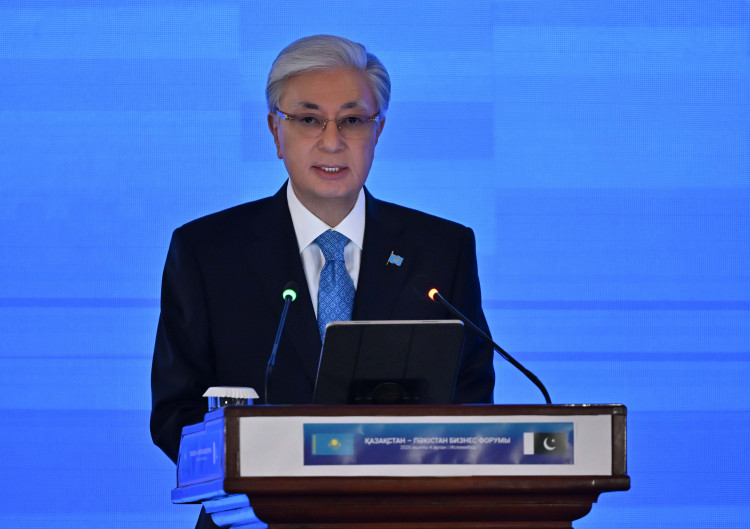
ISLAMABAD: Tall and composed, the president of Kazakhstan entered the room with an assured calm, greeting everyone with a warm handshake before we took our seats.
From the outset, Kassym-Jomart Tokayev carried the ease of a seasoned statesman and the confidence of a man who has helped shape a modern nation. Often described as one of the architects of contemporary Kazakhstan, Tokayev is best known for advancing the concept of a ‘listening state’, a governing philosophy rooted in listening to the people first and translating their concerns into opportunities, reforms and practical solutions. This was an exclusive one-on-one interview with this correspondent on Wednesday at a local hotel in Islamabad.
Among the Central Asian Republics, Kazakhstan stands out as one of the most influential and strategically significant states. Its president is a rare polyglot, fluent in Chinese, Russian, English, French, and several other languages, a skillset that reflects his long diplomatic career and global outlook. At the very start of the conversation, President Tokayev referred to his recent meeting with Prime Minister Shehbaz Sharif, speaking appreciatively of the Pakistani leader and setting a tone of warmth and mutual respect for the discussion that followed.
Q: How do you assess relations between Pakistan and Kazakhstan, particularly in terms of expectations, realities, and prospects for trade and investment cooperation?
A: Kazakhstan regards Pakistan as a friendly country and a strategic partner that has earned respect in the international community. Since the establishment of diplomatic relations in 1992, our two countries have worked together on many issues and projects of common interest. We maintain close and productive engagement with key international organisations, including the SCO, OIC and CICA, contributing to the promotion of global peace, stability, and sustainable development.
My first state visit to Pakistan aimed to broaden our partnership and open a new chapter in our relations. During the visit, governments and businesses signed more than 60 bilateral documents, providing strong impetus for bilateral cooperation. Priority areas of economic cooperation include transport and logistics, agriculture, industry and manufacturing, healthcare, education and several other sectors. I see substantial opportunities for companies from our two countries to establish joint ventures and implement mutually beneficial projects. One of our key priorities is to significantly scale up bilateral trade.
Q: What is the main direction of cooperation between Pakistan and Kazakhstan?
A: Economic cooperation and regional connectivity are central to our partnership. We aim to translate political goodwill into concrete economic outcomes, particularly through trade expansion, investment, and people-to-people links.
Q: Connectivity has become a major focus of your joint agenda. How important is this issue for Kazakhstan?
A: Connectivity has indeed become a top issue of our joint agenda. In this context, Kazakhstan is ready to participate in the development of the Kazakhstan–Turkmenistan–Afghanistan–Pakistan corridor, which we regard as strategically important for regional connectivity and access to South Asian markets. I am pleased to note that Pakistan has also shown a very positive approach towards close coordination in this strategically important project. We count on the active and coordinated participation of all stakeholders to ensure the successful implementation of transit and transport initiatives.
Q: Many politicians closely follow developments in the United States. How do you assess the current situation there, particularly US President Donald Trump’s domestic policies?
A: President Trump is a strong and forward-looking leader who puts the national interests of his country first. This is clearly reflected in the strong economic performance of the US economy, as well as in the transformative reforms currently underway, particularly in the social sphere. I am a committed supporter of his emphasis on common-sense policies and the restoration of law and order. Likewise, in Kazakhstan, we pursue a firm law-and-order policy to make our country stronger in today’s complex global environment. In my view, all citizens must comply with the law and respect law-enforcement agencies while avoiding any obstruction.
Q: Why did Kazakhstan decide to join the Abraham Accords?
A: Kazakhstan has always been firmly committed to the principles of peace, stability and international dialogue. The Abraham Accords, initiated by President Trump, represent a truly forward-looking initiative. By joining this framework, we reaffirm our belief in diplomacy as the most reasonable instrument for resolving differences and fostering long-term regional and global stability.
Kazakhstan maintains excellent relations with Israel, while at the same time consistently supporting the Palestinian people and advocating a two-state solution. From the standpoint of national interests, joining the Abraham Accords lays a solid foundation for attracting investment, advanced technologies and tangible economic benefits. I also hope that Kazakhstan’s accession will contribute to widening Arab–Jewish rapprochement into a broader Muslim–Judaic dialogue.
Q: Together with Prime Minister Shehbaz Sharif, you signed the founding agreement of the Board of Peace in Davos. Some see it as an attempt to create an alternative to the United Nations. What is your assessment?
A: The Board of Peace is a timely and relevant initiative designed to deliver swift and effective results. President Trump himself emphasised during the signing ceremony that the Board of Peace is intended to complement, not replace, the efforts of the UN, which is currently facing institutional strain. It is particularly significant that this initiative implements United Nations Security Council Resolution 2803, recognising that peace must be anchored in both international legitimacy and effective leadership. I am confident that the Board of Peace will make a meaningful contribution to strengthening global peace and stability through flexible and pragmatic mechanisms for conflict resolution.
Q: Do you believe that a long-term and sustainable peace plan for Gaza has a future?
A: The plan presented by Special Envoy Steve Witkoff and Jared Kushner appeared to be well-structured and ambitious, yet realistic. In certain aspects, it resembles a development-oriented project aimed at creating sustainable foundations for peace and prosperity. However, without genuine political will to move forward towards a two-state solution, no plan can be truly sustainable. This remains the only viable framework for breaking the recurring cycle of violence and instability.
Q: The war between Russia and Ukraine has become protracted. Do you see yourself as a potential mediator?
A: The situation is extremely complex and the core issue remains territorial in nature. Kazakhstan has consistently advocated for an exclusively political and diplomatic resolution to the conflict. In our view, the path to peace lies through negotiations between the opposing sides. While Kazakhstan does not seek a mediating role, we are ready to offer our good offices, including providing a neutral platform for negotiations, should such an opportunity arise.
Q: As an experienced diplomat, do you consider a military seizure of Greenland possible? What scenario do you find realistic?
A: I would approach this question somewhat differently. There are many comparable cases in international practice in which countries enter into long-term lease arrangements for specific territories or strategic infrastructure, often for shared, mutually beneficial objectives. Any decision of this nature must be considered strictly within the framework of international law, including respect for state sovereignty and the principles enshrined in the UN Charter.
As a practical option, it is suggested that the US and Denmark consider a 120-year leasing arrangement for Greenland. Under this arrangement, Greenland would legally remain part of Denmark, meaning Denmark’s sovereignty would not be violated or broken, while practical arrangements could serve shared strategic interests. Ultimately, through dialogue, responsible statecraft, and adherence to international law, I hope the parties will find a mutually acceptable and pragmatic agreement.
Q: Kazakhstan is currently discussing major constitutional amendments. What is the essence of these changes?
A: Our country is undergoing one of the most significant processes of political transformation in its history, ensuring that progress is shared fairly across society. We have undertaken nation-building efforts to modernise Kazakhstan and make it more just and fair.
Kazakhstan has moved away from a super-presidential system toward a presidential republic with consolidated checks and balances, grounded in a strong president, an influential parliament, and an accountable government. We are now entering a new phase of political modernisation. Major changes include the establishment of a single-chamber parliament, the National Council and the introduction of the position of vice president. Human rights and freedoms are proclaimed as the nation’s highest priority, with unity, interethnic harmony, and interfaith coexistence forming the foundation of our statehood.
Q: What development path has Kazakhstan chosen for the future?
A: We seek to build a just, safe, clean, and progressive Kazakhstan, where the principles of law and order prevail and social harmony is preserved. Today, Kazakhstan remains the largest economy in Central Asia. We have recorded strong economic growth, with GDP exceeding $300 billion and per capita income reaching historic highs.
Our investment policy focuses on maintaining a stable, transparent, and predictable business environment. At the same time, we aim to transform Kazakhstan into a fully digital state, harnessing artificial intelligence and advanced technologies. We also seek to position Kazakhstan as a key transit hub across Eurasia and are undertaking large-scale modernisation of our energy sector in close partnership with foreign investors. Taken together, this reflects our chosen development path: a diversified, technology-driven and globally competitive economy focused on improving the quality of life for our people.
source Exclusive interview: Kazakh president praises Trump policies, urges realism in global affairs
