

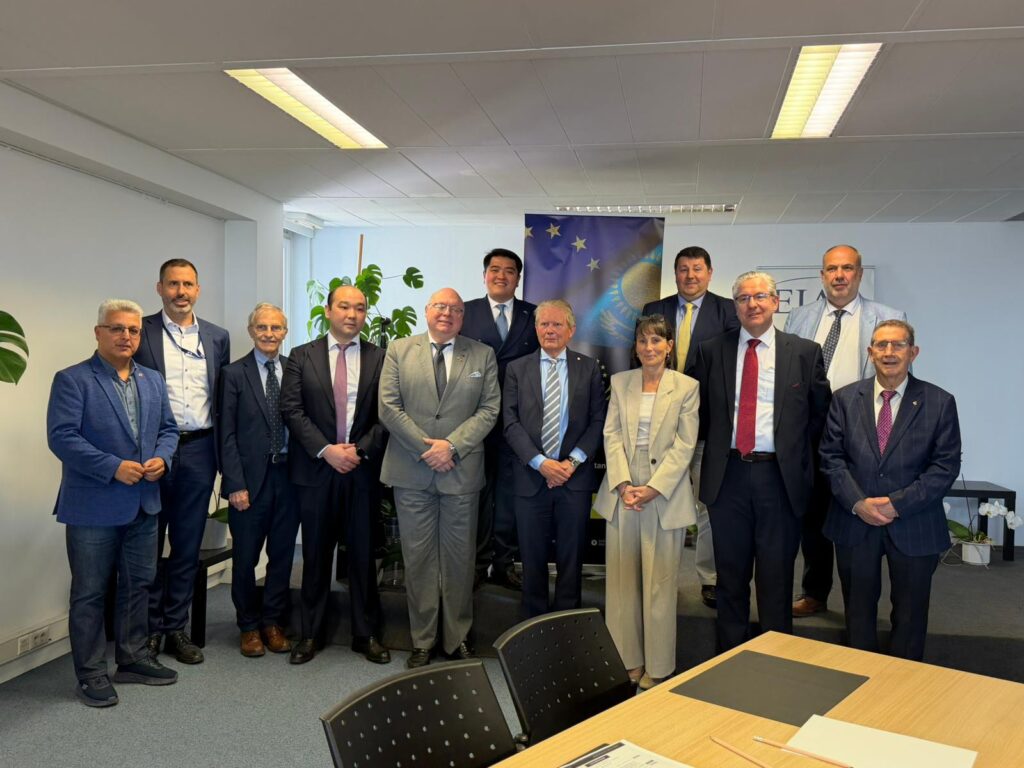
Kazakhstan–EU Gateway held High-Level Roundtable in Brussels, Highlighting Strategic Role of the Middle Corridor and Setting Path Toward Investment-Ready Implementation
Brussels, 29 April 2026 – A high-level international roundtable titled “Sustainable Middle Corridor: From Strategic Coordination to Bankable Implementation” convened in Brussels, bringing together senior representatives from the EU institutions, international financial organizations, logistics and transport companies, and stakeholders from Central Asia. The event marked an important step in advancing the Trans-Caspian International Transport Route (TITR), commonly known as the Middle Corridor, toward practical implementation and long-term investment readiness.
Organized by Kazakhstan–EU Gateway in cooperation with FERRMED and European institute for Asian studies, the roundtable provided a platform for in-depth dialogue on strengthening connectivity between Europe and Asia. Participants focused on how to translate strong political commitment into coordinated actions, scalable infrastructure projects, and efficient logistics solutions capable of supporting growing trade flows across Eurasia. As noted in the event materials, the Middle Corridor is increasingly recognized as a “strategically important link between Central Asia and Europe,” requiring transformation into “a technically efficient and financially viable logistics system” .
Geopolitical Context Driving Demand
Speakers highlighted that the Middle Corridor’s growing relevance is closely linked to recent geopolitical developments. In particular, disruptions caused by the war in Ukraine, as well as ongoing instability in the Middle East, have significantly affected traditional trade routes and underscored the need for diversification. Member of the European Parliament emphasized that the corridor offers a viable and politically sustainable alternative for Europe–Asia trade, reducing dependence on routes passing through high-risk regions and enhancing the resilience of global supply chains.
H.E. Roman Vassilenko, Ambassasor of Kazakhstan to the EU stressed that the current environment presents an opportunity, calling for a shift from political endorsement to concrete project implementation. Similarly, representatives of the European Commission Charlotte Adriaen underlined the importance of aligning regional infrastructure initiatives with EU programmes such as Global Gateway, particularly through improved regulatory coordination and cross-border integration.
From Strategic Vision to Operational Reality
A central theme of the discussion was the need to address operational inefficiencies and infrastructure gaps that continue to limit the corridor’s performance. Joan Amoros, Secrerary-general of FERRMED, emphasized the importance of integrated multimodal systems, noting that effective coordination between rail, maritime, and road transport is essential for improving efficiency and reducing logistics costs. He highlighted the role of high-capacity intermodal terminals and modernized infrastructure as key enablers of performance.
Godfried Smit, Secretary General of the European Shippers’ Council, provided a cargo-owner perspective, stating that the Middle Corridor has “rapidly moved from ‘alternative option’ to ‘strategic priority’” for companies seeking flexibility and risk diversification in an increasingly uncertain global trade environment . However, he also pointed out that the corridor remains a “work in progress,” identifying critical challenges such as multimodal complexity, bottlenecks in the Caspian Sea crossing, inconsistent customs procedures, and limited digital integration. According to Smit, addressing these issues is essential for achieving the predictability and reliability required by modern supply chains.
Industry Insights: Bottlenecks and Practical Challenges
Industry representatives reinforced these concerns by highlighting persistent operational constraints. Marc Billiet (International Road Transport Union) emphasized that administrative and regulatory barriers at borders continue to affect efficiency and transit times, calling for greater harmonisation of procedures across countries. Erik Van De Sande (TMCS) underscored the importance of advanced logistics management tools, including digital platforms capable of integrating data across the entire corridor.
From an operational standpoint, Dair Amirov (Kedentransservice JSC) pointed to limitations in rolling stock availability and terminal capacity, noting that infrastructure expansion must be accompanied by investments in transport assets to ensure smooth operations. Participants widely agreed that physical bottlenecks, particularly, in ports and ferry crossings across the Caspian Sea remain among the most critical constraints requiring immediate attention.
Financing the Corridor: From Concept to Bankable Projects
The second session of the roundtable focused on financing and investment, addressing the challenge of transforming infrastructure needs into bankable, investor-ready projects. Bauyrzhan Mukayev (Kazakh Invest) highlighted the corridor’s strong potential to attract international investment, provided that projects are properly structured and supported by clear regulatory frameworks.
Private-sector representatives emphasized that investor confidence depends on improved reliability, cost competitiveness, and transparency. Heinrich Kerstgens (Rhenus-Central Asia) noted that while interest in the corridor is growing, businesses require predictable transit times and competitive pricing to commit long-term volumes. Valikhan Bakhretdinov (Kazakhstan-EU Gateway) stressed that closer coordination among corridor participants is essential to ensure seamless operations and build trust among logistics operators and investors.
Digitalisation and Sustainability as Key Enablers
A recurring conclusion across all sessions was the critical role of digitalisation in enhancing corridor performance. Participants highlighted the need for integrated digital platforms enabling real-time cargo tracking, harmonised documentation, and seamless data exchange across borders. Such solutions are essential not only for improving efficiency but also for increasing transparency and meeting the expectations of global logistics markets.
In addition, sustainability considerations were identified as increasingly important, with stakeholders emphasizing the need to align corridor development with ESG standards and green logistics principles. This includes promoting energy-efficient transport modes, reducing emissions, and ensuring responsible infrastructure development.
Next Steps and Expected Outcomes
The roundtable is expected to produce a concise Chair’s Summary outlining key challenges and recommended actions, along with a shortlist of priority infrastructure and logistics projects with strong potential for EU and private-sector financing . As a follow-up, an Implementation Matrix will be developed to translate identified bottlenecks into concrete solutions, define responsible stakeholders, and outline indicative timelines for execution.
The discussions in Brussels confirmed a strong alignment among policymakers, financial institutions, and industry stakeholders on the strategic importance of the Middle Corridor. While significant challenges remain, there is broad consensus that ongoing investments, regulatory improvements, and digital integration efforts are moving the corridor in the right direction.
If sustained and effectively coordinated, these efforts will enable the Middle Corridor to evolve from a supplementary route into a core pillar of Eurasian connectivity—offering a resilient, efficient, and competitive alternative for trade between Europe and Asia in an increasingly complex global environment.
Kazakhstan–EU Gateway held High-Level Roundtable in Brussels | EUReflect | EUReflect
