

From Conflict to Connectivity: A Year of Peace Between Azerbaijan and Armenia
Anastasiya Lavrina, research fellow at the Institute for Development and Diplomacy of ADA University, political analyst
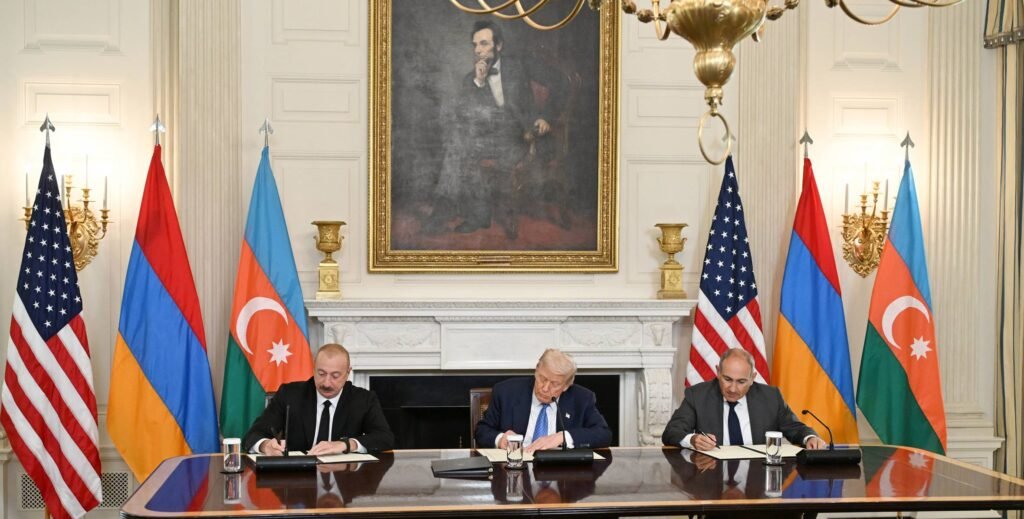
On 8 August 2026, the South Caucasus marks the first anniversary of one of the most consequential diplomatic moments in its modern history: the visit of President Ilham Aliyev to Washington and the signing of the Joint Declaration by President Ilham Aliyev and Armenian Prime Minister Nikol Pashinyan, under the facilitation of U.S. President Donald Trump. One year later, the significance of this event extends well beyond bilateral relations. It has become an important case study in how political leadership, evolving geopolitical realities, and international diplomacy can converge to reshape an entire region.
For decades, the South Caucasus was defined by unresolved conflict, geopolitical competition, and diplomatic deadlock. The absence of a sustainable settlement limited regional economic integration, weakened transport connectivity, and discouraged long-term investment. Today, while the normalization process continues, the strategic direction has fundamentally changed. Increasingly, the region is viewed not as a zone of permanent confrontation but as a future bridge linking Europe, Central Asia, and the Middle East.
The origins of this transformation did not begin in Washington. They emerged after Azerbaijan restored its internationally recognized territorial integrity, fundamentally changing the political environment in which peace negotiations could take place. The military phase created new realities, but it was diplomacy that determined how those realities would shape the future of the region.
One of the defining features of the post-conflict process has been Azerbaijan’s initiative in shaping the framework for peace. The five fundamental principles proposed by Azerbaijan—mutual recognition of sovereignty and territorial integrity, renunciation of territorial claims, non-use of force, border delimitation and diplomatic relations, and the restoration of regional transport links and cooperation—became the conceptual foundation of the peace process. In this sense, not only the idea of a peace agreement but also its substantive framework originated in Baku.
This reflects an important characteristic of President Ilham Aliyev’s foreign policy. Following the restoration of territorial integrity, Azerbaijan consistently shifted its diplomatic focus from conflict management toward regional cooperation, economic integration, and long-term stability. The objective was no longer simply ending a dispute but creating a new political and economic architecture for the South Caucasus based on international law, sovereign equality, and mutually beneficial cooperation.
Against this background, the Washington negotiations represented a historic diplomatic milestone. The United States, under the leadership of President Donald Trump, provided political facilitation at a moment when regional realities and international interests converged. Rather than replacing direct dialogue between the parties, Washington created favourable conditions for advancing negotiations and formalizing political commitments. This demonstrated how international mediation can be effective when it supports, rather than substitutes, regional ownership of the peace process.
The personal relationship between Presidents Ilham Aliyev and Donald Trump also became an important political factor throughout this period. President Trump repeatedly emphasized Azerbaijan’s strategic importance and publicly supported the peace process, while President Ilham Aliyev recently described President Trump as a « man of peace, »highlighting his role in facilitating the Azerbaijan–Armenia peace process. These public exchanges helped create a favourable atmosphere for the diplomatic breakthrough achieved in Washington.
Importantly, the first year after the Washington declaration demonstrated that normalization could generate practical results rather than remain solely a diplomatic aspiration. Political dialogue gradually translated into tangible cooperation in transport, logistics, trade, and humanitarian contacts. Although many issues remain unresolved, the process increasingly began producing visible benefits for both societies.
One of the clearest examples of the practical benefits of normalization came during disruptions affecting maritime transport through the Strait of Hormuz. Azerbaijan supplied fuel to Armenia and facilitated the transit of more than 26,000 tonnes of wheat, fertilizers, and other goods from Russia and Kazakhstan through its territory. Prime Minister Nikol Pashinyan acknowledged that securing alternative fuel supplies without Azerbaijan would have been significantly more difficult. These developments demonstrated how restored connectivity can strengthen regional resilience, diversify supply chains, and turn former lines of confrontation into corridors of cooperation.
The growing importance of peace is also reflected in the European Union’s high-level engagement with Azerbaijan. Recent visits by European Commission President Ursula von der Leyen, European Council President António Costa, and EU High Representative Kaja Kallas underscore that Brussels increasingly views stability in the South Caucasus as essential to Europe’s energy security, the Middle Corridor, and broader strategic interests. As Azerbaijan further strengthens its role as a reliable energy supplier and transport hub, lasting peace becomes not only a regional objective but also a strategic priority for Europe.
This broader strategic vision is reflected in the TRIPP (Trump Route for International Peace and Prosperity)project, also known as the Zangezur Corridor initiative. The route is intended to reconnect mainland Azerbaijan with the Nakhchivan Autonomous Republic through Armenia while becoming an integral part of the Middle Corridor linking Europe and Asia. The project is designed to unlock new opportunities for regional trade, investment, and connectivity, reflecting the understanding that sustainable peace cannot rely solely on political agreements but also requires practical economic cooperation capable of creating shared interests among neighbouring states.
President Ilham Aliyev’s role in shaping this transformation remains central. Azerbaijan has consistently argued that restoring its territorial integrity was the foundation for lasting peace based on international law, mutual recognition of sovereignty, and the absence of territorial claims. While important issues remain, including constitutional changes in Armenia to remove territorial claims and the conclusion of a comprehensive peace agreement, the trajectory has fundamentally changed.
One year after the Washington breakthrough, Azerbaijan and Armenia have completedtheir first year without military confrontation in modern history. At the same time, Armenia–Türkiye normalization has continued to advance, reinforcing broader regional stability. The logical next step is the signing of a comprehensive peace treaty that would formally conclude decades of conflict, establish a durable legal framework for interstate relations, and unlock the full potential of regional connectivity and economic cooperation across the South Caucasus.
