

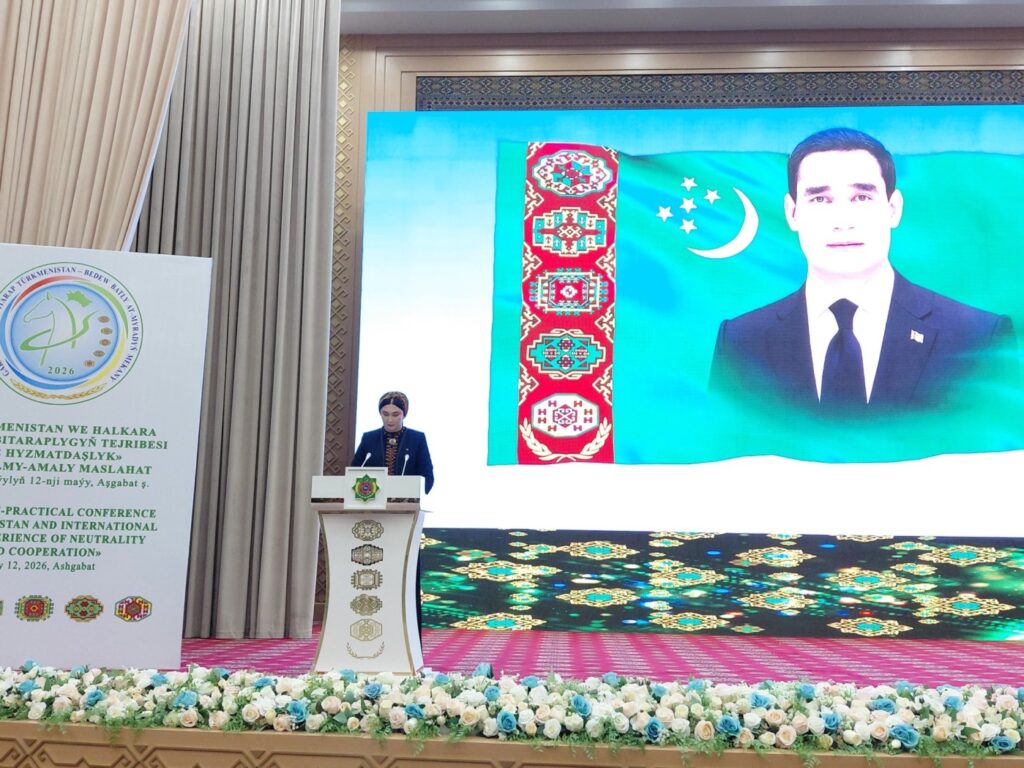
Turkmenistan has consistently positioned itself as an active platform for international dialogue by regularly hosting the International Scientific-Practical Conference “Foreign Policy and Diplomacy of Turkmenistan: Cooperation for Peace, Security, and Sustainable Development.” Organized in a hybrid format, these conferences are typically held in Ashgabat at the Institute of International Relations of the Ministry of Foreign Affairs. They bring together scholars, diplomats, policymakers, and international experts, reflecting Turkmenistan’s ambition to function not only as a neutral state but also as a convening hub for global and regional discussions on peace, diplomacy, and sustainable development.
These forums are deeply rooted in Turkmenistan’s foreign policy doctrine, which is guided by the principle of permanent neutrality, officially recognized by the United Nations. Within this framework, Turkmenistan seeks to present itself as a mediator capable of facilitating dialogue among states with diverse geopolitical positions. The conferences therefore serve as a concrete expression of this neutrality, promoting diplomacy as an alternative to confrontation and emphasizing negotiation, mutual respect, and confidence-building measures. In this regard, Turkmenistan’s neutrality is not merely a passive stance but an active diplomatic instrument aimed at conflict prevention and peaceful dispute resolution.
The thematic structure of these conferences reflects key priorities in Turkmenistan’s foreign policy. A central focus is placed on international law and global governance, particularly through the reinforcement of multilateral frameworks such as those of the United Nations. Turkmenistan actively supports global initiatives that aim to strengthen international cooperation, including the “Pact for the Future” and resolutions such as the International Year of Peace and Trust, which underline the importance of trust-based diplomacy in an increasingly fragmented international system. By situating its diplomacy within these global frameworks, Turkmenistan aligns itself with broader efforts to maintain international stability and promote inclusive governance.
Another major dimension of the conferences is regional connectivity, which occupies a strategic place in Turkmenistan’s external relations. Discussions frequently emphasize energy diplomacy, transport corridors, and infrastructure development linking Central Asia with South Asia, the Caucasus, and beyond. Projects related to gas exports, transnational pipelines, and multimodal transport corridors are presented as instruments not only of economic development but also of regional integration and interdependence. In this context, economic diplomacy is closely linked to peacebuilding, as increased connectivity is seen as a means of reducing tensions and fostering long-term cooperation among neighboring states.
The most recent edition of this international conference, held in May 2026 in Ashgabat, further illustrated Turkmenistan’s diplomatic outreach. The event gathered a diverse group of participants from Europe, Central Asia, and North America, including representatives from Germany, Belgium, France, Türkiye, Kazakhstan, Tajikistan, and the United States. This wide geographical representation underscores the country’s effort to engage both regional partners and broader international actors in discussions on peacebuilding and economic diplomacy.
Significantly, the 2026 conference was held alongside an international student olympiad dedicated to peaceful dialogue, highlighting an additional dimension of Turkmenistan’s diplomatic approach: the involvement of youth and academic communities in the promotion of peace. This initiative reflects an understanding that sustainable peace is not only the product of high-level diplomacy but also of education, cultural exchange, and the cultivation of a dialogue-oriented mindset among younger generations.
Taken together, these conferences illustrate how Turkmenistan seeks to combine neutrality, multilateralism, and regional cooperation into a coherent diplomatic strategy. By hosting such forums on a regular basis, the country reinforces its image as a neutral intermediary and contributes to shaping a discourse centered on dialogue, connectivity, and sustainable development. In an international environment marked by geopolitical tensions and fragmentation, these initiatives position Turkmenistan as a unique actor advocating for stability through diplomacy and cooperative engagement.
