

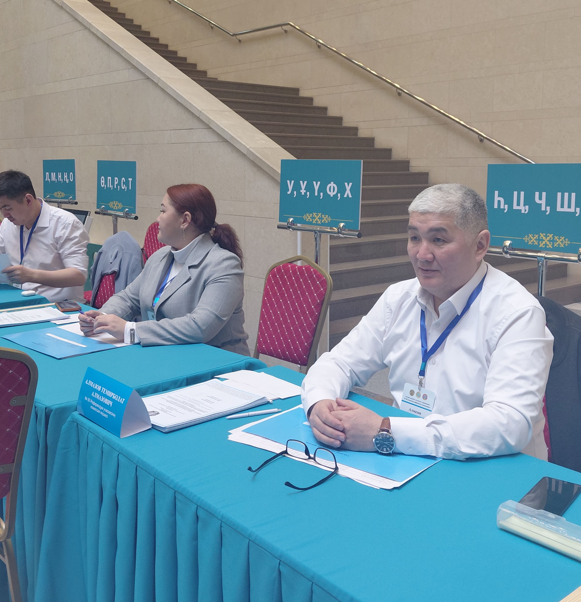
A constitutional referendum was held in Kazakhstan on 15 March 2026 to determine whether to approve a new constitution for the country. According to official results, it was supported by nearly 90% of voters, with 10% voting against.
This referendum represents a major milestone in Kazakhstan’s political evolution. It was the fifth referendum since the country’s independence and the third constitutional referendum since 2022, reflecting a sustained process of institutional reform and modernization. Media outlets from around the world covered the event extensively. “Kazakhstan: Largest country in Central Asia approves new constitution,” wrote Euronews.
President Kassym-Jomart Tokayev emphasized the historic nature of the vote, declaring: “Today we witnessed a truly historic event for our country. The citizens of Kazakhstan participated in the referendum and supported the constitutional reform. They cast their vote for the future of our country.”
The referendum follows President Tokayev’s 2025 State of the Nation Address, in which he announced major parliamentary reforms aimed at amending the 1995 Constitution.
The draft constitution proposed significant institutional changes, rewriting approximately 84% of the 1995 Constitution and introducing 95 articles. Among the key reforms are the replacement of the bicameral Parliament with a unicameral Kurultai, the reintroduction of the office of vice president, the strengthening of the separation between religion and state, and the expansion of civil rights protections.
It is important to recall that Kazakhstan has increasingly positioned itself as a democratic example in the region, particularly since the introduction by Tokayev of a single seven-year presidential term. During a post-vote interaction with journalists, he firmly dismissed rumors of an early presidential election, stating that the next presidential vote would take place as scheduled in 2029.
Transparency and International Observation
Kazakhstan’s Ministry of Foreign Affairs invited various international media experts to participate in observing the referendum and assessing the transparency of the electoral process.
Arman Issetov delivered a pre-election briefing to foreign media outlets such as EUReporter, EUAlive, CNN Türk, Aju Press, Free Eurasia, davdva.sk, and Nouvelle Revue Politique.
He highlighted Kazakhstan’s economic achievements, noting:
“According to the results of last year, Kazakhstan’s GDP amounted to 306 billion US dollars, which allowed our country to enter the list of the 50 largest economies in the world this year.”
Issetov also stressed that the new constitution was drafted with strong public participation:
“To systematize all proposals, a Constitutional Commission of 130 members was established. The Commission carefully reviewed and summarized more than 12,000 proposals submitted by citizens through the state digital platforms eGov and eOtinish. It is important to emphasize that the work of the Commission was fully transparent.”
On the eve of the referendum, foreign journalists attended a briefing at the Central Election Commission of Kazakhstan, conducted by Deputy Chairman Mr. Erman.
The Commission answered all questions, emphasizing that the draft constitution had been widely accessible:
“The draft constitution was published in all media—new media, traditional media—and also on platforms such as banking applications.”
They also underlined the importance of citizen participation:
“According to our constitutional law, in a public referendum, every citizen and every organization can express their opinion.”
Election Day and International observations
On the day of the vote, experts from around the world visited polling stations to observe voting procedures and verify transparency. Afterward, they delivered briefings to international journalists.
The French journalist Antoine Colonna noted the calm atmosphere across polling stations, emphasizing the absence of police forces in most of the locations visited. This was presented as evidence of a stable political climate in Central Asia’s largest democracy, with a population of just over 20 million.
Key Features of the New Constitution
The final draft, published on 12 February 2026, includes a preamble and 95 articles across 11 sections, addressing the foundations of Kazakhstan’s constitutional order, human rights, and state institutions.
Kazakhstan, a democratic, secular and unitary state
The constitution affirms Kazakhstan as a democratic, secular, and unitary state. It emphasizes the rule of law, sovereignty, and territorial integrity.
It also highlights the importance of the Kazakh language while ensuring the protection of the Russian language. Kazakh is established as the state language, while Russian retains official usage. Article 3 guarantees harmony among communities, reflecting the country’s multicultural identity.
Human Rights and Freedoms
The new constitution strengthens the protection of fundamental rights:
- The death penalty is explicitly abolished
- Privacy and digital rights are protected
- Family and personal freedoms are guaranteed
- Freedom of conscience and religion is affirmed
the Kurultai
A unicameral parliament, the Kurultai, composed of 145 deputies elected through proportional representation, replaces the previous bicameral system. Deputies serve five-year terms and must meet age and residency requirements.
The draft also introduces the role of vice president. This position becomes the second-highest authority in the country and ensures continuity of power in case of presidential incapacity.
The Halyk Kenesi
One of the most significant innovations is the creation of the Halyk Kenesi (People’s Council), envisioned by President Tokayev as “a new state apparatus to represent all ethnic, regional and civil society groups.”
This body will serve as the highest consultative institution, creating a direct channel between the state and society. Its objectives include strengthening public participation, evaluating social proposals, and ensuring institutional balance.
Kazakhstan is a multiethnic and multiconfessional state, making this institution particularly important. The Halyk Kenesi will:
- Ensure formal representation of all ethnic groups
- Include minority voices in policymaking
- Allow direct participation in legislative proposals
- Strengthen national unity and interethnic harmony
Comprising 126 members, including representatives from ethnocultural associations, civil society, and regional councils, it also grants minority groups the ability to influence legislation.
Additional Reforms
- Judicial independence is reinforced
- Municipalities and regions gain greater autonomy
- Gender equality and traditional family values are emphasized
- Secular education and cultural, scientific, and innovation policies are promoted
Marriage is constitutionally defined as a union between a man and a woman.
Sovereignty
The new constitution reinforces national sovereignty:
- It removes the primacy of international treaties over domestic law
- It strengthens territorial integrity and makes these principles immutable
Results of the Referendum
Strong support for the reform was observed in western regions such as Aktobe (93.96%) and Mangistau (93.40%).
Before the referendum, foreign journalists attended a roundtable organized by the CFIVE think tank.
At the event, Ralph E. Winnie Jr. highlighted Kazakhstan’s international positioning:
“For people looking to trade and invest in Central Asia, Kazakhstan is key. One of the most important developments is its engagement with the United States under Donald Trump and the signing of the Board of Peace.”
He added:
“When people see that over 12,000 proposals were submitted and that citizens feel invested in their country’s future, it sends a strong message to the United States government.”
During a briefing, Ömer Kocaman emphasized the symbolic importance of institutional reforms:
The transition from a bicameral parliament to a unicameral system named Kurultai reflects historical Turkic political traditions and reinforces Kazakhstan’s national identity in its 35th year of independence.
H.E. Ambassador Mutaz Faleh Saleh Alhiasat is an Expert in the New Challenges and Threats Dimension of CICA gave also an interview for EUReporter and said that
“At various voting stations, the entire referendum was conducted in conformity with applicable legal framework.
Wesley Alexander Hill, expert on grand strategy, geoeconomics, and international relations with a regional specialization in China, Eurasia, and Sub-Saharan Africa, noted during his interview that the participation in the referendum was high and important.
International Reactions
Following the referendum, several world leaders congratulated President Tokayev.
At the initiative of the French side, Tokayev held a phone call with Emmanuel Macron, who praised the referendum as a historic step forward in Kazakhstan’s modernization.
Kazakhstan remains France’s key partner in Central Asia.
Other leaders, including Shavkat Mirziyoyev, Sadyr Japarov, Ilham Aliyev, Nikol Pashinyan, and Asif Ali Zardari also sent congratulatory messages.
Conclusion
The 2026 constitutional referendum marks a decisive turning point in Kazakhstan’s political and institutional development. By combining structural reforms, enhanced civil rights protections, and increased citizen participation, the country is redefining its governance model while reinforcing its sovereignty and national identity.
Beyond its domestic implications, this reform sends a strong signal internationally: Kazakhstan is committed to stability, modernization, and inclusive governance. With broad public support and growing international recognition, the new constitution may well serve as a reference point for political transformation in Central Asia and beyond.
BIBLIOGRAPHY
Akorda.kz. (n.d.). President Tokayev holds a telephone conversation with President of France. Retrieved March 18, 2026, from https://www.akorda.kz/en/president-tokayev-holds-a-telephone-conversation-with-president-of-france-1722246 [kt.kz]
Brkic, B., & Khassenkhanova, G. (2026, March 16). Largest country in Central Asia votes for the new constitution. Euronews. https://www.euronews.com/2026/03/16/largest-country-in-central-asia-votes-for-the-new-constitution [euronews.com]
EUalive. (n.d.). Kazakhstan’s constitutional referendum: Tokayev reaffirms stability amid global tensions. Retrieved March 18, 2026, from https://eualive.net/kazakhstans-constitutional-referendum-tokayev-reaffirms-stability-amid-global-tensions/
Mazorenko, D. (2026, February 9). Kazakhstan’s new constitution and the balance of power. Vlast. https://vlast.kz/english/68292-kazakhstans-new-constitution-and-the-balance-of-power.html [usnews.com]
La Nouvelle Revue Politique. (2026, 17 mars). Antoine Colonna – Les Kazakhs valident la nouvelle constitution du Président Tokaïev. https://nouvellerevuepolitique.fr/antoine-colonna-les-kazakhs-valident-la-nouvelle-constitution-du-president-tokaiev/ [nouvellere…litique.fr]
Qazinform News Agency. (2026, January 29). From Vice Presidency to Qurultay: An overview of Kazakhstan’s constitutional reform agenda. https://qazinform.com/news/from-vice-presidency-to-qurultay-an-overview-of-kazakhstans-sonstitutional-reform-agenda-323212 [qazinform.com]
Qazinform News Agency. (2026, January 29). From Vice Presidency to Qurultay: An overview of Kazakhstan’s constitutional reform agenda. https://qazinform.com/news/from-vice-presidency-to-qurultay-an-overview-of-kazakhstans-sonstitutional-reform-agenda-323212 [qazinform.com]
The Times of Central Asia. (2026, March 16). New Constitution backed by majority as Kazakhstan reports record referendum turnout. https://timesca.com/new-constitution-backed-by-majority-as-kazakhstan-reports-record-referendum-turnout/ [timesca.com]
