

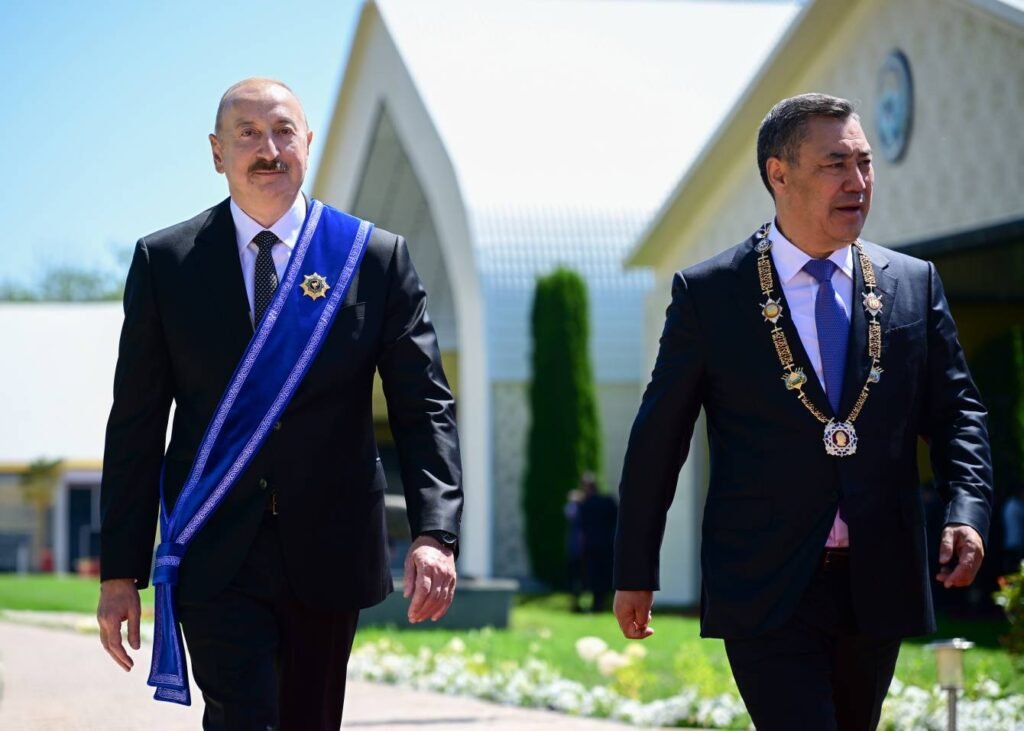
Kyrgyzstan is no longer known solely as the « Switzerland of Central Asia » for its breathtaking mountain landscapes. Today, it is increasingly emerging as a significant hub of international diplomacy. Between its historic election to the United Nations Security Council, visits by influential world leaders, and the return of the World Nomad Games, the country is demonstrating a steadily expanding role on the global stage.
2026, the year of Kyrgyzstan
The year 2026 has indeed marked a profound turning point for Kyrgyzstan, driven by major shifts in domestic power dynamics, landmark diplomatic milestones on the global stage, and a strategic push into regional integration and green mobility.
A Seat on the United Nations Security Council
In June 2026, Kyrgyzstan was elected as a non-permanent member of the United Nations Security Council for the 2027-2028 term. Its victory over the Philippines represents a historic recognition of the country’s growing diplomatic relevance and international credibility.
To underline Kyrgyzstan’s new position in world affairs, UN Secretary-General António Guterres is scheduled to visit Bishkek during the Summit of the Shanghai Cooperation Organisation (SCO), which Kyrgyzstan is hosting and chairing.
Issyk-Kul as a Regional Hub
The shores of Lake Issyk-Kul are becoming an increasingly important venue for Eurasian political and economic dialogue. For many years, Kyrgyzstan was primarily known for its spectacular mountains, nomadic traditions, and the turquoise waters of Lake Issyk-Kul. In 2026, however, the country emerged as something far more significant: a growing diplomatic and cultural power at the crossroads of Eurasia. The informal summit on July 31, 2026, in Cholpon-Ata on Lake Issyk-Kul, where Central Asian leaders and Azerbaijan’s President Ilham Aliyev signed the Cholpon-Ata Declaration.
The Return of the World Nomad Games in 2026- Soft power
Kyrgyzstan is also strengthening its international profile through cultural diplomacy and soft power.
More than 3,000 athletes from over 100 countries are expected to participate in the sixth edition of the World Nomad Games.
The importance of Japarov and the new Kyrgyzstan
Since Sadyr Nurgozhoevich Japarov assumed power, Kyrgyzstan has entered a new period of growth and influence. Rising from humble beginnings to the highest office in the country, Japarov has become one of the most influential leaders in Kyrgyzstan’s modern history. His presidency has been marked by bold reforms, strategic diplomacy, and a strong emphasis on national sovereignty. Under Japarov’s leadership, Kyrgyzstan has achieved notable progress in economic development:
- The nationalization of the Kumtor gold mine brought billions in revenue to the state and symbolized the reclaiming of national resources.
- GDP and the state budget have grown steadily, with investments in infrastructure, energy, and industry.
- Strategic projects such as the Kambar-Ata-1 hydroelectric plant and the China–Kyrgyzstan–Uzbekistan railway are transforming the nation’s economic landscape.
On the social front, Japarov has introduced reforms to support families, increase pensions, and improve public services—reflecting a people-centered approach to governance.
Kyrgyzstan is experiencing rapid economic growth this year. The well-known Kazakh newspaper Qazinform wrote: “Kyrgyzstan’s economy is growing at a rapid pace.”
According to the Eurasian Development Bank’s weekly macroeconomic review (as reported by Kabar), Kyrgyzstan’s gross domestic product increased by 11.7% in the first four months of 2025.
Key drivers of economic growth:
- Industry: +2.6 percentage points in GDP growth
- Construction: +2.5 percentage points (Key projects include the Issyk-Kul ring road, urban infrastructure in Bishkek, and tourism development)
- Domestic trade: +2.0 percentage points
According to preliminary estimates from the National Statistics Committee, GDP for January–March 2025 totaled 329.1 billion soms, with real growth of 13.1% (compared to 10.0% for the same period in 2024).
By sector:
- Industry: +16.0%
- Services: +8.7%
- Construction: +69.0%
- Agriculture: +2.5% according to the Ministry of Economy and Commerce of the Kyrgyz Republic.
Gross industrial output reached 159.2 billion soms—an increase of 16.3% compared to 2024—driven by:
- Refined petroleum products: ×1.9
- Food, beverages, and tobacco: ×1.7
- Pharmaceuticals: +41.7%
- Rubber, plastic, and construction materials: +43.0%
- Wood, paper, and printing products: +29.9%
- Chemicals: +8.5%
- Basic metals: +3.2%
In 2020, Kyrgyzstan’s GDP stood at 639 billion KGS ($7.3 billion). By the end of 2025, it is projected to reach 1.8 trillion KGS ($22 billion).
President Sadyr Japarov has emphasized the importance of technological independence, digital data protection, and the development of national IT infrastructure.
Japarov’s role in driving this economic momentum has been significant.
A New Era of Leadership
Japarov became president in January 2021 after a period of political unrest. His rise was fueled by popular support and a promise to restore stability, fight corruption, and strengthen the rule of law. His leadership style blends pragmatism with a strong nationalist vision, aiming to empower Kyrgyzstan both domestically and internationally.
Peace with Tajikistan: A Diplomatic Breakthrough
One of Japarov’s most historic achievements came in March 2024, when Kyrgyzstan and Tajikistan signed a landmark peace agreement resolving long-standing border disputes. On March 13, 2025, this was solidified with the signing of the Kyrgyz–Tajik border agreement by President Japarov and Tajik President Emomali Rahmon, finally settling the 984-kilometer boundary between the two nations.
“From now on and forever, the border between the Kyrgyz Republic and Tajikistan will be the border of eternal friendship,” Japarov declared during a joint statement.
He also announced the resumption of flights between the two countries, suspended for about four years, with Somon Air’s Dushanbe–Bishkek route reopening. Plans for future bus services aim to further connect the two peoples. Japarov pledged support for preserving the Tajik language within Kyrgyzstan and for the work of civil society organizations.
According to his cabinet, the agreement will help “strengthen the security, stability, and sustainable development of the Kyrgyz Republic and Tajikistan, as well as all of Central Asia.”
The accord—which included land swaps and the creation of neutral transit routes—ended decades of tension. It stands as a testament to Japarov’s ability to resolve complex geopolitical disputes through negotiation and compromise.
Constitutional Reform
One of Japarov’s most consequential moves was the April 11, 2021 constitutional referendum, which replaced the semi-parliamentary system with a presidential one. The new constitution centralized executive power in the presidency, giving Japarov direct authority over cabinet appointments and dismissals.
This reform ended the decade-long experiment with parliamentarism introduced in 2010, shifting the political balance heavily toward the executive.
Perhaps the most symbolic economic policy of Japarov’s presidency was the 2021 nationalization of the Kumtor Gold Mine. This act, presented as a defense of national sovereignty, resonated strongly with domestic audiences but raised concerns among foreign investors. For Japarov personally, the Kumtor case was pivotal—his political career was shaped by the 2013 Kumtor protests, during which he was imprisoned on kidnapping charges. The mine’s nationalization thus carried deep political and symbolic meaning.
Japarov has built his legitimacy on promises to confront “corrupt elites who robbed the state.” High-profile prosecutions reinforced his strongman image, although human rights reports suggest anti-corruption campaigns were at times used to sideline political opponents (U.S. Department of State, 2023).
A Eurasian Diplomatic Vision
Japarov’s foreign policy is rooted in multi-vector diplomacy—balancing relations with Russia, China, Central Asian neighbors, and global institutions. He has strengthened Kyrgyzstan’s position in the Eurasian Economic Union (EAEU) and the Collective Security Treaty Organization (CSTO), while pursuing regional projects such as CASA-1000 and the Middle Corridor.
He has maintained traditional alliances with Russia, deepened economic cooperation with China through the Belt and Road Initiative, and elevated Kyrgyzstan’s role in the Organization of Turkic States (OTS), enhancing ties with Türkiye, Azerbaijan, Kazakhstan, and Uzbekistan.
A President Close to the People
Japarov actively cultivates an image of being “close to the people” (халык менен байланышы), particularly resonating with rural communities. His frequent use of social media and direct engagement with citizens reinforce the perception that his policies reflect public opinion.
CONCLUSION
President Sadyr Japarov is widely seen as a transformational figure in Kyrgyz politics. His tenure blends assertive leadership, diplomatic skill, and a strong sense of national identity. By prioritizing sovereignty, stability, and development, he has positioned Kyrgyzstan as a confident and constructive actor in Eurasia.
By asserting national sovereignty, fostering regional peace—most notably with Tajikistan—and driving impressive economic growth, Japarov has positioned Kyrgyzstan as a rising force on the international stage. His leadership reflects a new era of stability, pragmatism, and ambition, making him not only a key actor in domestic politics but also a respected statesman across Central Asia.
In 2026, Kyrgyzstan moved beyond its traditional image as a mountain nation and emerged as a dynamic actor in Eurasian affairs. Through diplomatic achievements, the international prominence of Issyk-Kul, closer cooperation with Azerbaijan and the wider Turkic world, and the successful revival of the World Nomad Games, the country has significantly increased its regional and global profile.
From the shores of Issyk-Kul to the halls of the United Nations in New York, Kyrgyzstan is demonstrating that influence is not determined by size, but by vision, diplomacy, and the ability to connect cultures and regions.
For Kyrgyzstan, 2026 may well be remembered as the year it stepped confidently onto the world stage.
References
- Баш мыйзамдын жаңы долбоору: диктатуранын илеби. (2020, November 18). Platforma.kg.
- Berloto, S., & Fasola, N. (2024). Kyrgyzstan 2021–2024: Japarov’s seizure of power amidst structural challenges. Asia Maior, XXXV.
- Bisarya, S. (2022). No half-measures—From semi-presidentialism to full presidential systems in Kyrgyzstan and Haiti. In Annual Review of Constitution-Building: 2021. International IDEA.
- Дононбаева, А. А. (2016). Конституционные реформы в Кыргызской Республике. Актуальные проблемы гуманитарных и естественных наук, 12-3, 53–56.
- IFES. (2021). Kyrgyzstan: 2021 Local Elections and Constitutional Referendum (FAQ).
- Куватова, А. (2021, March 16). Нарушение регламента ЖК: почему референдум и изменение Конституции нелегитимны. 24.kg.
- Мамбетова, Г. (2022). Садыр Жапаровдун эл менен байланышы жана популисттик риторикасы. Илим жана коом, 15(2), 88–99.
- RFE/RL. (2023, February 13). Kyrgyzstan’s Kumtor Gold Mine and the Fall of a ‘Great Nomad’.
- U.S. Department of State. (2023). Investment Climate Statement: Kyrgyz Republic.
- ZOiS Spotlight. (2022, October 19). The Violence in Kyrgyz Gold.
- Eurasian Research Institute. (n.d.). Sadyr Japarov’s era in Kyrgyzstan: An evaluation on foreign policy and economic developments. Retrieved from https://www.eurasian-research.org/publication/sadyr-japarovs-era-in-kyrgyzstan-an-evaluation-on-foreign-policy-and-economic-developments/
- Meduza. (2024, October 25). Dispatch from Issyk-Kul: How nationalizing Kyrgyzstan’s largest gold mine won President Japarov the people’s support. Retrieved from https://meduza.io/en/feature/2024/10/25/dispatch-from-issyk-kul
- Osmonalieva, B. (2025, August 14). President Japarov sends greetings to Economic Forum participants in Cholpon-Ata. 24.kg. https://24.kg/english/339586__President_Japarov_sends_greetings_to_Economic_Forum_participants_in_Cholpon-Ata/
- Seilkhanov, A. Kazinform. (2025, May 13). EDB: Kyrgyzstan’s economy is growing at rapid pace. Retrieved from https://qazinform.com/news/edb-kyrgyzstans-economy-is-growing-at-rapid-pace-762569
- The Europe Today. (2025, March 18). Historic peace deal between Kyrgyz Republic and Tajikistan: A new era of hope. Retrieved from https://theeuropetoday.com/2025/03/18/historic-peace-deal-between-kyrgyz-republic-and-tajikistan-a-new-era-of-hope/ 24.kg News Agency. (2024, December). Sadyr Japarov: Kyrgyzstan’s economy is reaching new level of development. Retrieved from https://24.kg/english/314874_Sadyr_Japarov_Kyrgyzstans_economy_is_reaching_new_level_of_development/
